
What Is Value Chain Analysis And Why Is It Important?
by Diane M. Calabrese | Published February 2026
Soybeans have been getting a lot of attention—not because huge swaths of the world’s population acquired a taste for the cooked beans but because of the way soybeans get bandied about in discussions of tariffs.
People may not consume many soybeans in their original state, but said legumes are the starting point for products ranging from tastier foods to degreasers. (Methyl soyate contributes to low VOC [volatile organic compound] degreasers used in our industry.)
A standing crop of soybeans has value. So does the acreage on which it grows, the water that hydrates it, and the energy required to harvest it.
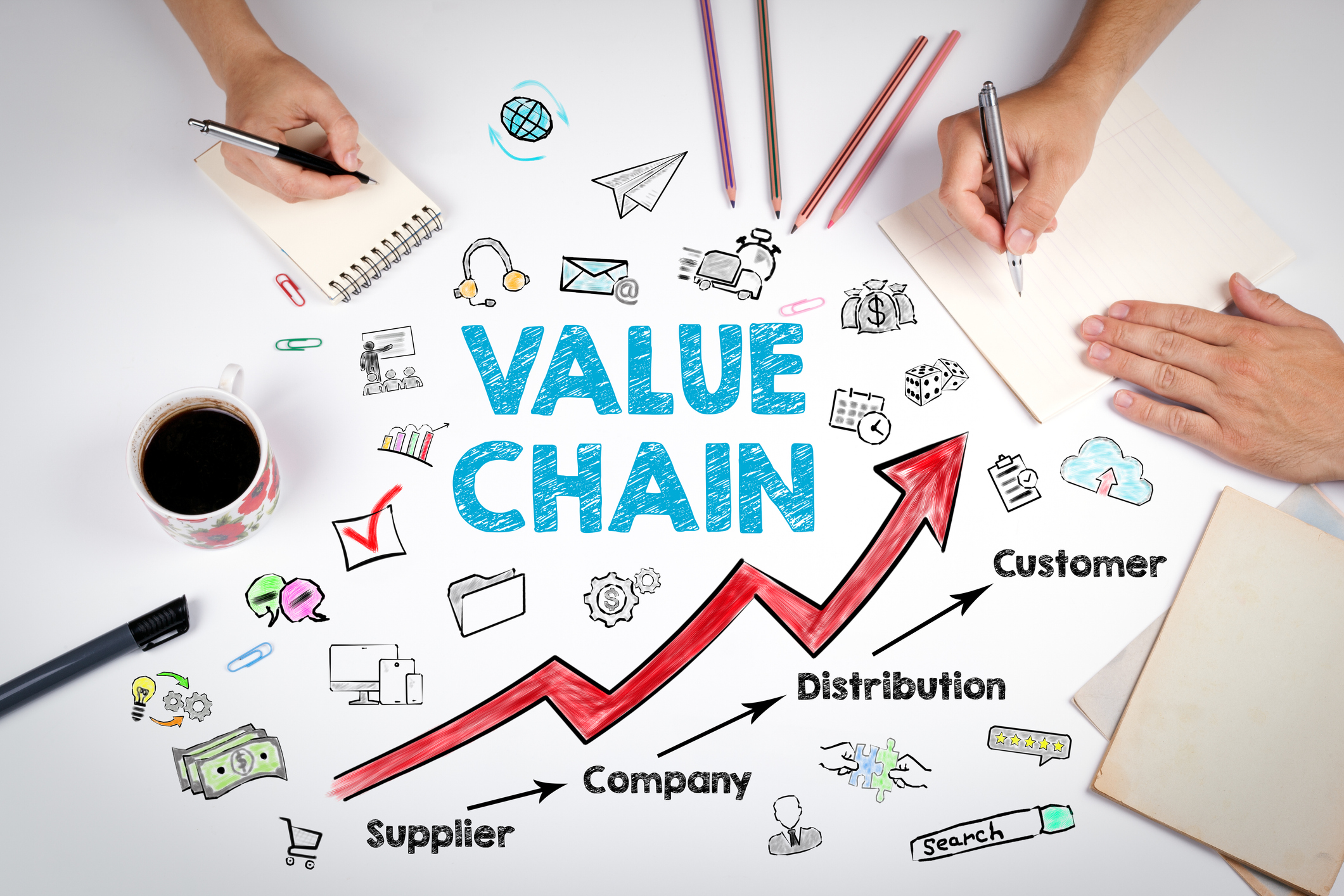
When a buyer in China purchases soybeans from one of the big producers (Argentina, Brazil, or the United States), the price established reflects the sum of the value chain (to that point).
The chain continues as the buyer uses the beans to feed livestock or make other products. By analyzing a value chain, we get a clearer understanding of not only the costs to make a product that has value but also of the interconnectedness of everything. And make that interconnectedness at the global level.
Tariff discussions become wearying, yet we note that value chain analysis has utility in determining the size and placement of tariffs.
Here we focus on what value chain analysis is and why it’s important. In a companion article, we consider some of the many uses of value chain analysis—yes, including use by the U.S. Bureau of Economic Analysis (BEA) that weighs in regarding tariffs.
A Name of Its Own
Michael Porter is credited with introducing the term “value chain” in 1985. A professor at Harvard Business School, Porter used the term in his book The Competitive Advantage: Creating and Sustaining Superior Performance.
The Harvard Business School itself makes freely available a primer titled Understanding the Value Chain, which was primarily authored by Tom Strobierski in 2023 and since updated. (See https://online.hbs.edu/blog/post/what-is-value-chain-analysis .)
Before we continue along the “what is” path, however, let’s pause to consider whether the name launches the concept, or whether the concept antedates the name. From our perspective, in one way or another, value chain analysis has been part of doing business for as long as there have been individuals selling products and services.
Make that millennia. Farmers had to account for the amount they paid for manure and the cost of hiring helpers when they set the price on a bushel or bag of crops. Thus, they were analyzing the value chain.
In the same way, individuals who gathered manure and hauled it to farmers’ fields were adding the cost of maintaining their horses (or other draft animals) and wagons or skids to the price they charged farmers. Today, most definitely, the value chain moniker and value chain analysis apply to both products and services.
So, value chain analysis is not new. And it’s not actually a difficult concept. In house, a business owner operates on a similar tract when evaluating cost centers and profit centers.
In some ways value chain analysis is the global level application of a local level process. As such, it’s not surprising that the concept of value chain analysis overlaps with the kind of financial analysis that businesses do with benchmarking tools.
The quest for specificity in the monetary value that should be assigned to every part of a chain leading to a product or service exists because the knowledge can be tapped to make adjustments – and in the words of Professor Porter, gain a “competitive advantage.”
That advantage may be refined by any adjustment in the chain. The adjustment could be changing a supplier, garnering more repeat customers, or changing a process that’s integral to the chain.
As every business owner knows, the theory of business and the practice of business frequently diverge. But it’s fun to look at some of the models that the value chain analysis concept has inspired.
Snake, spider, and “sniker” [snake plus spider] sum up three models. The snake symbolizes addition of value in a sequential way. The spider symbolizes input to a core (spider body) via several routes (spider limbs). And, yes, the sniker is a hybrid of the two models.
Models of all sorts can be found. Some such as the spider with only six limbs will make some skeptical. (Spiders have eight appendages, insects have six.) The point is made, though, that theory and practice often diverge.
Does that mean that value chain analysis isn’t useful? Quite the opposite given that any method that encourages a business owner to take a closer look or gain a fresh perspective on costs in and value out is informative.
In fact, a member of our industry endorses the approach, and he tells us why.
An Industry Endorsement
“In my opinion, the Harvard Business School three-step value chain analysis is exceptionally valuable for the cleaning equipment industry because it provides a clear, disciplined way to understand where we create real value across manufacturing, distribution, service, and customer support,” says Gus Alexander, CEO of FNA Group in Pleasant Prairie, WI. And he goes on to emphasize differentiation as advantageous.
“By breaking down our operations into core activities; examining the true drivers of cost, performance, and service quality; and identifying where competitive advantage is strongest, the model reveals exactly where we can differentiate—whether through better engineering, smarter supply chain decisions, stronger distributor partnerships, or superior after-sales support,” says Alexander.
“In an industry where margins are tight, customer expectations are rising, and technology is accelerating, the three-step analysis gives us a practical, fact-based roadmap to eliminate inefficiencies, invest in the right innovations, and elevate value across the entire chain,” explains Alexander. “It turns strategy into actionable decisions that directly improve reliability, dealer satisfaction, and long-term competitiveness.”
Seeing parallels between evaluating cost centers (the traditional approach to business monitoring and planning) and value chain analysis (dissecting the value to the bottom line contributed by each cost center}, we ask Alexander where he sees the differences and similarities.
In the traditional approach, cost centers are often measured in isolation, explains Alexander. The typical question answered is whether something stays within budget.
“[Value chain analysis] measures value creation relative to cost,” says Alexander. “Does it improve competitiveness, profitability, or customer value?”
It’s important to be able to control spending but not to the extent of putting a halt on creation. Alexander explains, “In short, traditional cost-center evaluation asks, “Are we spending wisely? Value chain analysis asks, “Are we creating maximum value?”
In the 1969 movie version of Hello, Dolly!, Dolly Levi used a metaphor to impress on Horace the importance of extracting maximum value. She said that money is like manure: it must be spread around to make the most of it.
Determining how much and where to spend gets easier when coupled with value chain analysis. For instance, the analysis may encourage investment in high-impact areas even if costs are higher, explains Alexander.
Shift in focus away from cost control to value creation is just one of the “main strategic implications” of value chain analysis, says Alexander. Others include utility of the method in the exposure of inefficiencies and opportunities across the entire chain, illumination of where resources are wasted, alignment of departments around customer value, and optimizing decisions.
Exposure of inefficiencies and opportunities across the entire chain is a thread that returns us to the example of soybean tariffs. When China imposed a huge tariff on U.S. soybeans, all parties that contributed to the value of the beans that languished were affected.
Businesses that sold fertilizer to soybean farmers, businesses that sold equipment or did transport for soybean farmers, etc. were all affected. So, too, were contract cleaners who washed farm equipment and trucks used in the sector.
In other words, and this is something BEA is studying, the effect of a sudden perturbation to a value chain—whether tariffs or cataclysmic crop loss—diminishes value realized by each of the contributors to the final product (soybeans). If buyers stop buying, the value contributed by each link in the chain cannot be realized.
And that’s because the value of the final product cannot be realized. Of course, beans could be sold elsewhere, but if sold for less in a new market, all those who contributed to the chain must reconfigure.
While the endpoint—the product or service—may receive the focus, value chain analysis clarifies the components that contribute to the value of the endpoint. Moreover, components are not static.
“Activities” go into each component. For instance, procurement of a particular component for the final product or service involves everything from evaluation of suppliers and shippers to ascertaining the quality of the component. In that context, it may be possible to reduce the cost of a component because one supplier charges less for shipping, but how reliable is the lower-cost shipper?
“Highly impactful” is the phrase Alexander uses to sum up value chain analysis. And “Using Value Chain Analysis,” the companion article to this one, will explore some of the impactful results of using the analysis.
Current Digital Issue
|
|
Click to read.
|

Go Mobile