
Using Value Chain Analysis
by Diane M. Calabrese | Published February 2026
It’s not just the product or service that has value. Every contribution made to the final product or service does.
Identify the links in a chain that leads to a product or service, and if nothing else, there’s a better understanding of all that went into arriving at the end point. The better the links are understood, the more they are appreciated.
As we wrote in the companion article to this one, “What Is Value Chain Analysis, and Why Is It Important?” something as straightforward as changing the price of a product or service affects the value of every part of the chain.
A contractor adds 10 percent to the price per square foot of an exterior house wash. The contractor has calculated that although business may drop by five percent, the net will be a plus.
So far, so good. But if the contractor does five percent fewer exterior house washes, there will be a chain reaction (however small or large) that will include buying less chemical and less fuel.
The chemical and fuel suppliers will sell less, and they will buy less from their suppliers. And the contractor may extend the life of equipment enough by doing less and earning more, which means a loss of sales for a distributor.
Value chain analysis reminds us that no decision made in the realm of economic activity stands alone. Is it important to acknowledge that? Yes, because doing so helps to bring logic to a discussion of everything from tariffs to taxes.
In mid-December, the mayor of Chicago advanced an idea to raise more revenue. The idea—still floating around as we write—was to levy a $33 per employee monthly tax on every business with 500 or more employees.
A business with 500 employees would suddenly owe $16,500 per month to the city in addition to other taxes. Where will the business get the money to meet the tax? We all know the alternatives.
One of the most important aspects of value chain analysis is that it discourages shortsightedness in the assignment of value. It forces a thoughtful approach to making changes.
Think it through. Slow down. Avoid hasty decisions. Such admonishments are taken seriously by theoreticians who advocate the use of value chain analysis.
What about practitioners? Successful business owners usually deploy a version of value chain analysis as a matter of good business planning without getting mired in theories.
For instance, a manufacturer might wonder whether offering its main pressure washer line in a new striking color would add value to the final product. Perhaps.
But what will it cost to change the color? Can the color paint be supplied by the current paint supplier for the same price? Has the color been tested for wear? How many buyers choose equipment on the basis of color—and some do—all else being equal?
For a manufacturer, a change in paint color may seem like a minor one in the context of its operations. But if a change requires a switch to a new supplier, a supplier that may be less reliable than the one in place, it becomes a problem.
Moreover, the original supplier may become unhappy with the reduction in orders (even though the manufacturer is still buying other paints) and in the perturbed state, raise prices on other items.
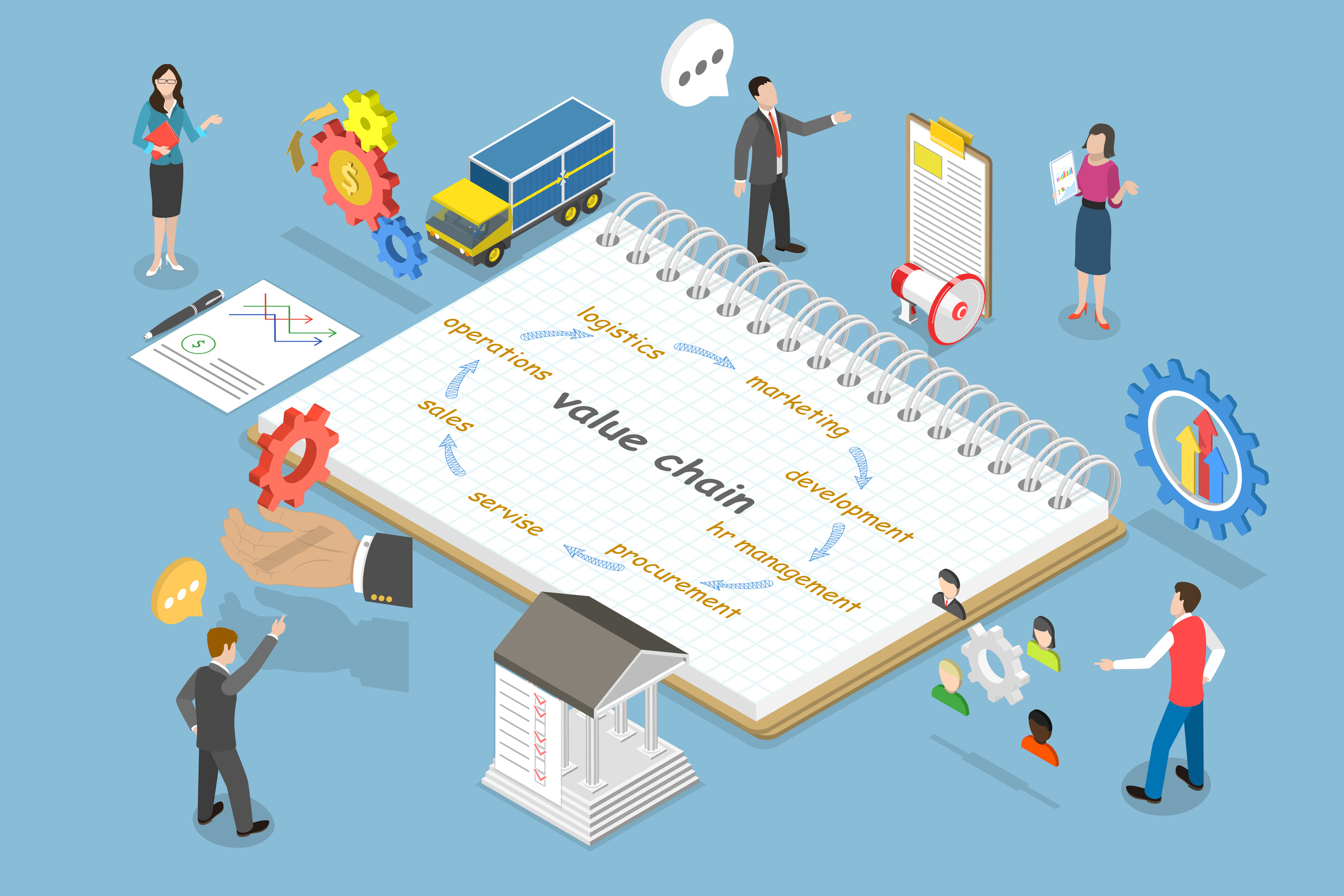
There are many ways that a value chain can be broken down for analysis. Michael Porter, who gets credit for naming the concept, used five subdivisions: inbound logistics, operations, outbound logistics, marketing and sales, and post-sale services (and a reminder that Porter’s 1985 book is titled Competitive Advantage: Creating and Sustaining Superior Performance).
As we look at the five categories, we realize they are useful for manufacturers, distributors, and contractors alike. Post-sale services may be one of the most interesting parts of the value chain in 2026 because the emphasis on customer relationship management is intense.
So intense that almost any purchase results in some follow-up from the seller requesting completion of a survey or inviting the submission of an online review. Does asking the buyer to contribute time in this way add value to the product, or does it discourage a repeat purchase?
On the other hand, speeding access to parts, repairs, and routine maintenance will get the sort of word-of-mouth accolades from customers that elevate the value of the product in the minds of would-be buyers. It’s about sorting through the chain to make certain that each link is as strong as it can be and no links are twisted.
Complement to Benchmarking
At the level of a single company, once a business plan is implemented, there are various ways to run checks on it. A business can benchmark in two ways. One, it can check its outcomes in each category it wants to assess (e.g., sales, sales per sales representative, year-over-year increase in sales).
Two, the business can allow its data to be aggregated with similar companies so that it gains insight into where it fits. Are similar companies doing more with fewer employees or with less square footage or with fewer vehicles, etc.?
Many financial analytical firms offer fee-based benchmarking. In our industry, the Cleaning Equipment Trade Association (CETA) offers benchmarking as a part of membership to those who wish to participate.
Benchmarking is business-centric. One business learns how it stacks up against others.
Value chain analysis evaluates all the factors that go into the value of the product or service a business offers. It is product or service focused. Again, what all went into that product or service?
Because all that went into the final product or service may reach across many places, global value chain analysis has become a pervasive term. As we wrote in the companion piece to this article, as discussions of tariffs multiply, so does the recognition that value chains offer a way of understanding just how much integration there is among the contributions to a product or service of value.
The term “supply chain,” which value chain has largely supplanted, focused on the logistics involved in making a final product. It suggested a linear progression from raw material to the deliverable to an end user.
There are elements of a supply chain in a global value chain. But they may be offshoots or appendages that feed into the main chain.
To summarize, value chain analysis is the stuff of business theory. At the company level, it’s all about practice with theory helping to refine ideas and practice.
Who’s Interested?
A 2020, a Congressional Resource Service (CRS) report written by Liana Wong titled Global Value Chains: Overview and Issues for Congress (https://www.congress.gov/crs-product/R46641) gives us much to consider in terms of why so many seem suddenly so interested in the concepts of value chain analysis and global value chains (GVCs).
According to the CRS report, each year two-thirds of world trade takes place via GVCs. By overlaying GVCs with advantages realized from reduced trade barriers and global communication networks, companies can choose to link with businesses in developing countries (for one).
By building a final product or service via GVC, one that includes new contributors, a company in a developed country may help to bring economic opportunity to the country of a new contributor. Such analysis informs the way congressional representatives formulate policy on exports and favored trading partners.
On a parallel track, the U.S. Bureau of Economic Analysis (BEA) has been working to quantify the way imported global content combines with U.S. content and production to produce U.S. exports. In June 2025, BEA introduced an interactive Trade in Value-Added (TIVA) tool.
Using the TIVA tool, a user can generate a custom table to better understand export data. For example, how much of the export value was contributed by imports to the United States?
Federal entities dealing with everything from agriculture to trade use value chain and GVC analyses. One analysis in 2008 came down on the side of killing poultry instead of trying to treat for highly pathogenic avian influenza (HPAI).
Some viewed the extermination (and others since) as extreme when a pharmaceutical intervention was possible. But by analyzing the contributors to the final poultry product, the kill-and-start-over approach was determined to be the better choice.
There was competitive advantage to be gained in killing instead of treating chickens–advantage because it was an expedient way to regain the trust of consumers. The faster trust was reestablished, the faster all those who contributed to the value chain—feed suppliers, bedding suppliers, contract haulers, etc.—could again be engaged.
Too much of a good thing applies everywhere, including in the use of value chain analysis. Often, common sense could get a company to the same decision point.
And there’s a risk that a company will become so consumed with dissecting the contributors to final value of service or product that it wastes time, money, and energy without realizing any competitive advantage for its efforts.
Persimmon-colored pressure washers may be nice, but wholly unnecessary in gaining competitive advantage. Common sense and experience are also allowable tools to continue to use along with helpful new metrics.

Current Digital Issue
|
|
Click to read.
|

Go Mobile