Setting Up Your Rig
by Diane M. Calabrese | Published May 2025
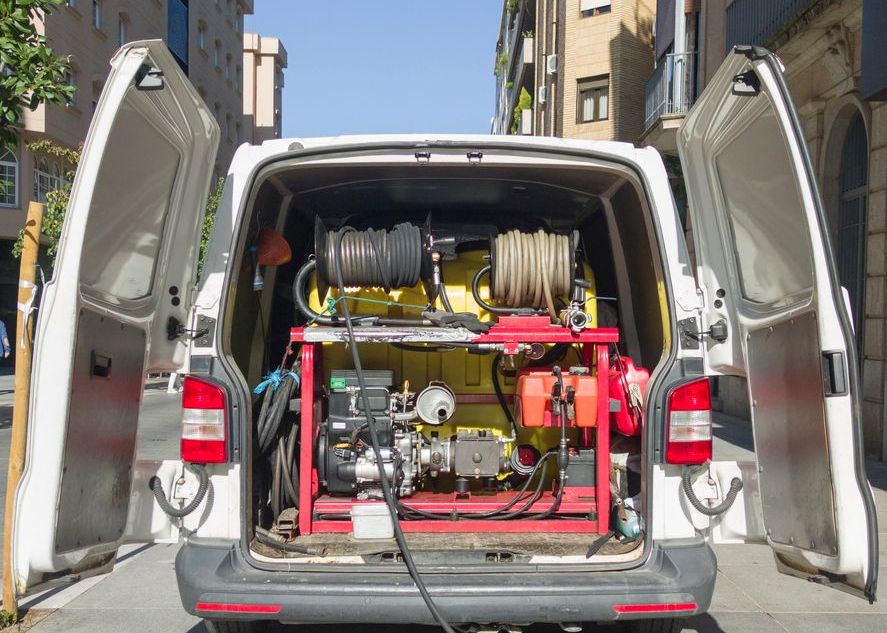
Every rig must have wheels, even a horse-drawn wagon. Let’s make wheels the universal requirement for a rig. (Skids are passé.)
Beyond that, the options start with box truck, van, pickup, trailer and combinations of the options. The type of work a contractor does will factor in the choice of conveyance.
Contractors that use ladders but stay on one job site an entire day may not find it cumbersome to carry ladders on a rack atop a box truck. Moving from one site to another in a single day may require an easier on/off.
Many choices must be made when setting up a rig. But before getting to them, a contractor should commit to two things: organization and neatness.
Yes, organization overlaps with neatness. Having a rig that’s well-organized speeds retrieval and makes it easier to track the need for resupply. But remember the way neat and clean fit together.
The best-organized rig operated by the most reliable contractor will send off some negative messages to prospective clients if the rig is not clean. Things happen. Mud splatters. Just don’t wait too long to clean that vehicle.
Neat. Clean. Easy to remember.
Add ‘safe’. Also easy to remember.
We just assume that every contractor attends to rig safety before doing anything else. Licenses and insurance are in place. And the vehicle poses no hazards to self or others when moving.
Beyond the basics of vehicle safety, however, there are a few more essentials a rig operator ought to keep in mind. The American Red Cross (RedCross.org) offers many useful reminders about the items that should be carried to enhance safety on the road.
All are worth considering and most are probably already part of the contractor’s roster of must-have items. Among them are a first aid kit, emergency radio, flashlight (and batteries), jumper cables, spare tire/inflator/repair kit, and portable power backup.
An insurer and/or license grantor for the rig will probably have requirements for carrying flares, reflective triangles, and a fire extinguisher. Even without such requirements, the safety items should be carried. And be sure they are secured so that they do not become projectiles if the rig gets a jolt. (Some parts of the nation have potholes that rival developing canyons.)
Duct tape is also recommended by the Red Cross as an item to always have on hand for safety. It can be used for a temporary fix in a windshield, for instance
Of course, temporary fixes should be just that. Get a new battery. (Don’t keep recharging a dying one.) Get the windshield repaired as soon as possible. And make sure tires match.
Safe, neat and clean – that’s what a rig should be.
Getting Started
So how do rig owners get the rig setup just right? Do they rely on trial and error, or did they start with a technique they learned from a colleague or other resource?
“There are many small things that make a rig more efficient – like organizing storage, placing hose reels on the optimal side for workflow, and keeping essential tools within reach,” says George Clarke, an exterior cleaning contractor/consultant with Outdoor ProWash LLC in Nashville, TN. “But one of the best improvements I’ve made is adding a remote-control setup for my heater and soap application.
“Early on, I had to manually adjust my soap mix or heater, which meant extra trips back and forth to the rig,” continues Clarke. “With a remote system, I can control these settings from wherever I’m working, saving time and reducing unnecessary wear on my equipment. It has streamlined my process significantly.”
In other words, achieving the optimal setup is an ongoing process. Be open to new approaches. Implement them if they improve the operation.
Some contractors work in regions with well-defined seasons. Should they make changes to conform?
“I like my rig to be ready for any season,” says Clarke. “If you operate in an area with freezing winters, you have two choices: shut down and winterize or have a streamlined system to winterize quickly when unexpected freezing temperatures hit.”
Even in most parts of the country with winter weather, there are intervals when contractors can work. And mobility of homeowners in this century is just one reason a contractor may find clients in January. Before a home goes on the market, even in winter, exterior cleaning improves its curb appeal.
“For me, I winterize any rig I don’t need and keep my main rig stored in the shop with a diesel-fired heater controlled by a thermostat,” says Clarke. “This way, I’m always ready to go, no matter what the day brings.”
Another time-saving — and weight-saving — technique Clarke has developed is to leave behind items that are rarely needed on a job. But that doesn’t mean they are not easily retrieved.
“[We] have small adjustments we can make depending on the job,” explains Clarke. “There are some items we rarely use, but we keep a designated spot for them on the truck in case they’re needed. This allows us to prepare quickly and adapt to different conditions without completely reconfiguring the rig.”
There are two accessories that every contractor should carry to each job, says Clarke. “A water key and a PK1390LFLW self-draining vacuum breaker for fine-thread hose bibs are essential. The water key ensures access to water sources that require it, which can be a lifesaver when dealing with commercial properties or certain residential setups”
[Caution: In some states and local jurisdictions use of a water key is restricted to a representative of the water company or the company’s designated representative on site. Know the rules that apply to the place where the work is being done.].
“The PK1390LFlW vacuum breaker is even more crucial because when it’s missing from a property’s hose bib, the connection is left with a fine-thread fitting where a standard garden hose thread should be,” says Clarke. “This makes it impossible to attach a regular hose unless you have the correct adapter.
“The vacuum breaker not only prevents backflow contamination and meets compliance requirements, but it also converts fine threads back to a useable garden hose thread.,” continues Clarke. “Since it’s self-draining, it also prevents freezing in colder months. Keeping one on hand has saved me from job delays countless times.”
Are there any common mistakes in setting up a rig that could easily be avoided? Yes.
“Many newcomers underestimate the importance of a redundant backup system, whether that’s an extra unloader valve, a spare pressure hose or even an alternative water source,” says Clarke. “Having a backup plan can mean the difference between finishing a job smoothly or losing a full day of work due to equipment failure.”
The “alternative water source” Clarke mentions can get a contractor through a job where service to the site has been suspended because of ongoing repairs to a broken water pipe. It is also something to consider incorporating in areas where water restrictions have become more severe because of drought.
Contractors who carry water to a job site may entice clients with that extra service. It’s something to keep in mind in a competitive marketplace – and of course, to advertise.
Perfection is a process
Methods and equipment change over time. A rig setup must adapt to accommodate new sizes and shapes of machines and ancillaries. Aim for perfection. Yet be prepared to make adjustments whenever needed.
Don’t hesitate to sketch out concepts for the ‘ideal’ arrangement and think them through. Get advice from colleagues when talking with them in professional settings (e.g., UAMCC and PWNA meetings). There’s no reason everyone cannot have a perfect setup.
It’s a truism that the best laid plans go awry. The key is to prevent them from getting twisted to the extent possible.
When a rig has a designated place for everything, it may not be satisfying but it does simplify things to know that something was left behind (and is not hidden from sight somewhere on the rig). If equipment and ancillaries are not stowed away with rigor, a lot of time could be wasted looking for something that was not on the rig.
There will be times when a contractor must carry supplementary equipment. Perhaps a special job requires a steam cleaner, and a rented machine must have space to reside on the rig. Thus, try not to fill every bit of available space on a rig – just in case an open area is needed.
Some contractors who operate vans find it easier to rent a trailer and hitch it to the van than to leave space on the van for special equipment needs. The arrangement can be convenient. But it must also be cost effective.
Make things as simple as possible when setting up a rig. Anchor everything tor transit with tiebacks. Consider putting padding around hoses so they are not damaged by something nearby that snags them. Etc.
Learn from experience. If the setup doesn’t work, change it. Don’t waste time lamenting an arrangement. Permanence and perfection are not the same thing.
Current Digital Issue
|
|
Click to read.
|


Go Mobile