Current Digital Issue
|
|
Click to read.
|

Pressure Washer’s Guidebook: Commercial Cleaning: Dealing with the Public
Contributors: Gene Beck, Owner, NorthStar Pressure Washing Services, LLC Houston, TX and Scott Stone, Owner and General Manager, A Mind for Detail, Inc. Mesa, AZ / Published June 2016
G
eographical Considerations
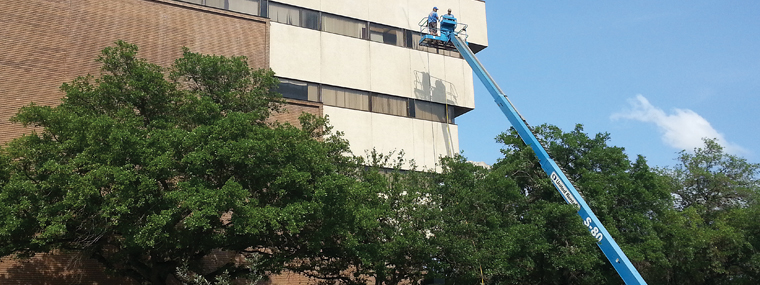
The safety of members of the public near work sites is the priority of contractors from Boston to St. Louis to Los Angeles. Spatial arrangement and the population density of a place determine how difficult the task will be. Each region also has unique challenges.
Beck: Houston, the core of the region we serve, has very strict cosmetic wash water guidelines, so the combination of special training and collection equipment is a must for our team.
Stone: We are based in Phoenix, AZ. Due to one of our specialties, cleaning bus stops, we are in contact with the public at nearly every location. On a daily basis, we deal with the homeless, inebriated individuals, disabled persons, and regular passengers. The largest challenge in dealing with the public is requesting that they move so that we can perform the work that we are contracted to do. Sometimes in the summer months, it is a challenge to ask people to move because no one wants to stand in the searing Arizona summer sun while we take the time to perform our task.
Typical Job
Beck: Maintenance cleaning of restaurants and strip-mall centers is our bread and butter. We also do high-end residential cleaning. On most of our commercial work, our interaction is minimal. Mainly, the use of safety cones and tape to keep the public from driving through the jobsite is all that’s needed.
Stone: The vast majority of our work is cleaning bus stops. We also clean parking garages and do other government contract work. Our cleaners are trained to maintain verbal communication and have situational awareness with the people in the area. The training maintains the safety of the cleaner and also helps to maintain the safety of the passengers coursing through the bus stops.
Techniques That Work Best
Keep the focus on safety and geniality to have a positive interaction with the public.
Beck: Safety, safety, safety. You can never have enough cones, safety tape, reflective clothing, and lights.
Stone: Courtesy and humor are key to working commercial jobs. No one likes dealing with someone who is dour in their appearance or attitude. We go to great lengths to have our cleaners be as unintimidating as possible. Sometimes it is hard to have the cleaner catch the vision of what is expected of them in the performance of their responsibilities. This is why constant training and retraining is important to maintain company standards and expectations.
Exceptions
Stone: We deal with the public much more than the typical power washer company. We do have people call in on occasion to report a misdeed of our cleaner. As a company, we maintain video records of the services performed. We do this to protect our cleaners. We have found that the vast majority of the reports of bad behavior are false reports.
If there is a situation that comes up during the performance of work, our cleaners are told to leave the area, and if threats are made, to make a police report. Our employees are repeatedly reminded that they should never be in a position to have a physical altercation. They are required to have a cell phone with them, just for occasions where police assistance is needed. It is interesting to note that as a contract comes up for renewal, we tend to see more and more false reports of everything from a physical altercation to an improperly cleaned stop.
Equipment and Supplies
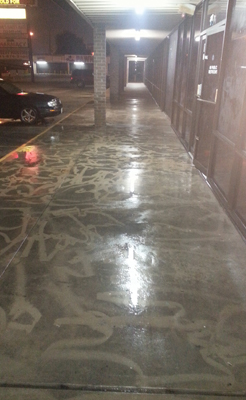
It’s important to be sure the public is kept safely separated from equipment and supplies in a staging area, as well as the work area itself.
Beck: Depending on the situation, we will use a combination of cones and safety tape. If a jobsite requires it, we will also use personnel to direct pedestrian traffic out of work areas.
Stone: Our equipment is all truck- mounted, and trucks are parked in the traffic lanes. We typically do not have a problem. Our equipment is never left on the ground or in public areas. As soon as work is performed, the equipment is replaced on the truck.
The only problem we have ever had is someone getting in one of our trucks and driving off while our cleaner is outside. Because of the number of stops that we do, we leave the truck running all day. Our employees are required to lock the door at each stop and have a door key to open the door. Every time a truck has been stolen, it was 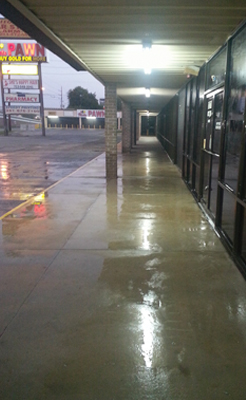 because an employee did not perform as expected and tried to save what amounts to one second by not locking the door.
How To Bill
Certain commercial jobs are in areas with so much complexity (e.g., high density population) that billing must be adjusted accordingly.
Beck: There are always factors that can affect the final price of a job. Is it daytime or nighttime? Is it a 24-hour facility? We visit each and every job before giving a proposal so that all the variables can be factored into our bids.
Stone: We are under a contract rate, so all those things that complicate a job are taken into account when the contract is bid.
Ancillaries
Working on a commercial job can become an advertisement in itself, but it should be a quiet, unobtrusive one. Passersby see and take note of the work in progress and appreciate seeing a good outcome and competence.
Stone: Everything we do is an advertisement. Adequate markings—logo, signage—on the truck are the major form of advertisement. Because of our market, we maintain a simple, clean, professional appearance—the same as a large construction company would do.
Problem Areas To Avoid
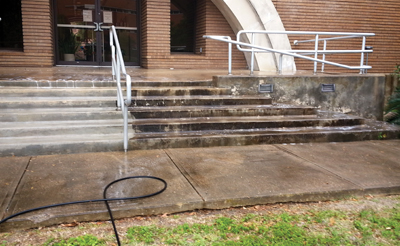 Even it if will only be an extra vehicle or a bit more noise affecting a neighboring structure, be sure to try to talk with the neighboring owner before starting a project. The outreach shows concern and professionalism.
Beck: In tight quarters, such as one building attached to others that are not being cleaned, always talk with adjacent owners in advance to let them know about the work you will be doing and how it will impact them.
How To Fix Mistakes
In a tight fit, an adjacent structure may be hit with spray. (This possibility is something to tell the near neighbors about prior to starting the job.)
Beck: Rinse, rinse, and rinse some more…
Stone: We have received occasional calls about overspray. Since we work in the public right of way, it is considered a known risk of parking in those areas. I have offered to pay for a car wash on occasion, but typically, we offer nothing because usually if the vehicle is hit with overspray, it is parked illegally.
Gene Beck owns NorthStar Pressure Washing Services LLC, which is listed in the buyer’s guide of Building Owners and Managers Association [BOMA] Inter-national. His company does both commercial and residential cleaning in the Houston area.
Scott Stone owns and operates A Mind for Detail Inc. with his wife, Cheryl. The couple started A Mind for Detail in 1989, and the business has grown into a multimillion dollar cleaning company. Their specialty is government contracting and services.
Go Mobile