
Current Digital Issue
|
|
Click to read.
|


Nozzles: Your Basic Questions Answered
By Diane M. Calabrese / Published June 2016

Water towers dot the rooftops of New York and stand as focal points (and name bearers) in less-populated towns. But unless they rupture, topple, or become depleted, they attract little attention.
Taken for granted (like every part of municipal systems), water towers work in consort with pipes and ultimately nozzles to produce the refreshing spray for a morning shower. Absence of shower spray signals a problem which could be local (nozzle), distant (tower), or in-between (municipal pipe or our pipe). That’s when the sorting out (and possibly plumber calls) begin.
In short, a nozzle cannot do it alone, whether it’s part of a shower head or a pressure washer. We focus here on the nozzle of a pressure washer.
Industry experts respond to some basic questions about nozzles. The experts are Jeffrey Paulding, president of Dirt Killer Pressure Washers, Baltimore, MD; Dave Hildebrand, vice-president of Barens Inc. Seneca, PA; Skip Markowitz, president of EDI Distributors Inc. Cherry Hill, NJ; and Carey French, service manager of Cam Spray, Iowa Falls, IA. [See also the accompanying sidebar prepared by Richard Rauckhorst, president of Arthur Products Co., Medina, OH.]

Cleaner Times [CT]: What is the single most important thing that a contractor should understand about the role of the nozzle in a pressure washer?
Paulding: The nozzle does not create the pressure in and of itself. The pressure washer pump creates a specific amount of flow. By damming the flow with nozzle, you create the pressure—much like when you put your thumb over the end of a garden hose to create a more powerful stream of water. The nozzle is part of a system and must be properly sized to be correctly paired with the flow of the pressure washer. Putting on too small a nozzle can over-pressurize the pump and cause problems. Putting on too large a nozzle lowers the pressure, meaning a loss of efficiency and cleaning power.
Markowitz: Some say that the pressure washer was invented when man first put his finger over the end of a garden hose and noticed the increase in pressure. That’s a pretty rough analogy, but a nozzle is just a fixed opening (orifice) of a certain size which, when installed downstream from a high pressure washer, will create a specific pressure. Just like the thumb, the larger the opening [permitted], the less the pressure.
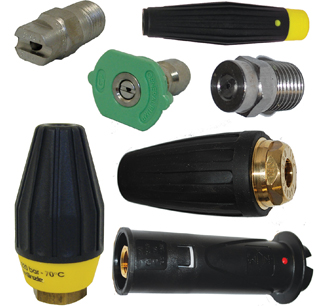
Nozzles are rated by a size such as 3.0, 3.5, 5.0, 6.5, etc. These numbers relate to a diameter in millimeters or inches, but the number system is much easier to follow.
 Many contractors believe that the nozzle number defines the flow rate, which is true only at certain pressures. Pressure (psi), flow rate (gpm), and nozzle orifice (size) are related by a fairly complicated algebraic formula. Much easier to understand is a chart describing the relationship. [Markowitz says that one produced by Barens Inc. is very understandable, with an online calculator at its website.]
French: Regarding size—if a nozzle is not sized correctly you will not get your full pressure or flow, depending if it is too big or too small.
Hildebrand: The single most important thing a contractor should understand is the nozzle actually creates the pressure. With no nozzle, only inlet water pressure (approximately 50 psi) will flow through the spray gun. Also, if a nozzle is sized too small, the machine will create more pressure—and if too large, less pressure.
CT: Is there any change in the function of a nozzle that might signal a problem with the pressure washer as opposed to an obvious problem with the nozzle itself?
Paulding: A drop off of pressure or flow signals a problem with the pressure washer pump or the unloader.
French: Usually a problem with the pressure washer itself will not change the pattern of the nozzle. If there is a problem with the nozzle, you will notice a change in the pattern.
CT: Is there a top reason why a nozzle might fail?
Paulding: Ordinary flat tip nozzles don’t really fail. They wear out, causing a loss of pressure and efficiency, or they clog. Clogging is the biggest problem for nozzles. Rotary nozzles are another matter. They can fail if the ceramic seat or tip cracks or the turbine becomes damaged.
CT: What protocol should a contractor follow in order to identify the optimal nozzle for a particular job?
Paulding: Nozzles need to be paired with specific pressure washers based upon the pressure and flow specifications of each pressure washer. Often the manufacturer will specify the correct nozzle size on the data plate of the pressure washer. If not, using the pressure and flow specifications of a pressure washer, a contractor can consult a nozzle chart to determine the proper nozzle size for their pressure washer. [He recommends as a sample of the many excellent charts available, this one: www.ultimatewasher.com/nozzles-size-pressure-washer.htm.]
If a contractor uses multiple pressure washers that call for different nozzle sizes, he must be careful to make sure the nozzle of the proper size is used with each pressure washer or he could be creating maintenance problems for himself.
Markowitz: Typically, the easiest way to adjust the pressure for any specific job is by selecting the correct nozzle size. So for a certain flow rate, let’s say five gpm, enter [a standard nozzle selection chart with flow on the left and psi on the top] the chart on the left at five gpm. The numbers in the body of the chart are nozzle sizes. Read across to any particular nozzle size, then up to find the pressure. Note that for any certain flow rate, as the nozzle size gets smaller, the pressure will increase.
So where do we stop? At the pump and engine (or motor) maximum ratings. The equipment manufacturer will tell you this. You can always use a larger nozzle than the manufacturers suggestion but not smaller.
Hildebrand: The one thing most users, either contractors or retailers, misunderstand is how to determine the proper nozzle size. Many of them think when a nozzle has a number such as 1505 stamped on it, the nozzle is for a 5 gpm machine. This is most of the time incorrect. The proper size is calculated based on a formula using the machine gpm and psi. Most pressure washer vendors have a chart in their catalogs showing the proper nozzle size.
CT: How should nozzles be maintained?
Paulding: Keep them clean and free of dirt.
Hildebrand: If using a rotating nozzle, there are two recommendations for proper nozzle maintenance. First, always use an inlet high pressure filter. This prevents small particles from entering the nozzle and cracking the ceramic components or preventing the rotor from spinning. Also, start the nozzle pointing at the ground to prevent the rotor from slamming into the ceramic of the nozzle, thereby cracking both.
CT: What should we have asked you about nozzles?
Paulding: My answers are based upon standard flat tip pressure washer nozzles. Specialty nozzles, such as rotary nozzles, and variable (vario) nozzles have additional features and problems.
CT: There is plenty of turn-key assistance available from manufacturers and vendors regarding nozzle selection. Search for ‘nozzle charts’ on the web. Or, visit the online archive of this magazine.
Guide To Identifying Optimal Nozzle For A Particular Job (Line Cleaning as Example)
Contributed by Richard Rauckhorst of Arthur Products Co., Medina, Ohio
The following are areas that a contractor must know in order to identify a nozzle that will accomplish the end objective: There is not a single nozzle which will address all situations that a contractor may encounter while cleaning lines. The contractor must know and understand the following for nozzle selection:
• System specifications (power washer system)
• Pressure (psi)
• Flow (gpm)
• Hose fitting size (npt)
• Length of hose (ft)
• Water Temperature (hot or cold) The nozzle is a conduit to direct the water through orifices that channel the water streams in the desired configuration to address the cleaning application at hand.The nozzle is one component of a pressure water system. The contractor must also know the cleaning objective. The following example applies to line cleaning.
• What is the size of the line to be cleaned? • What is the material that is to be removed from the line?
• What is the percentage of blockage in the line?
• What is the distance that the hose and nozzle must travel?
• What is the geometry of the line— straight run, 90° elbows, Y’s, T’s, etc.?
With the above information known for line cleaning, a contractor should be able to select one of the appropriate nozzle(s) below:
• Penetrator—typically one forward jet and three to six rear jets. The penetrator is used to penetrate a complete blockage.
• Flusher—typically six rear jets, used to flush out loose debris
• Deicer-Degreaser—three forward angled jets and six rear jets. Used to remove ice blockages and to remove grease build-up on pipe interior walls.
• Impactor—one forward jet, three side jets, and six rear jets. Used to penetrate blockages, slice the blockage into manageable segments, and flush any residual debris.
• Cornering—one forward jet, one side jet and three rear jets. Used to navigate through pipes with convoluted geometries and provide penetrating and flushing.
• Revolving—two side rotating jets and two rear rotating jets. Used to polish the walls of a pipe to recover optimum pipe flow.
Go Mobile