

Keeping a Clean Garage: Help Concrete Realize Its Full Lifespan
by Diane M. Calabrese | Published December 2025
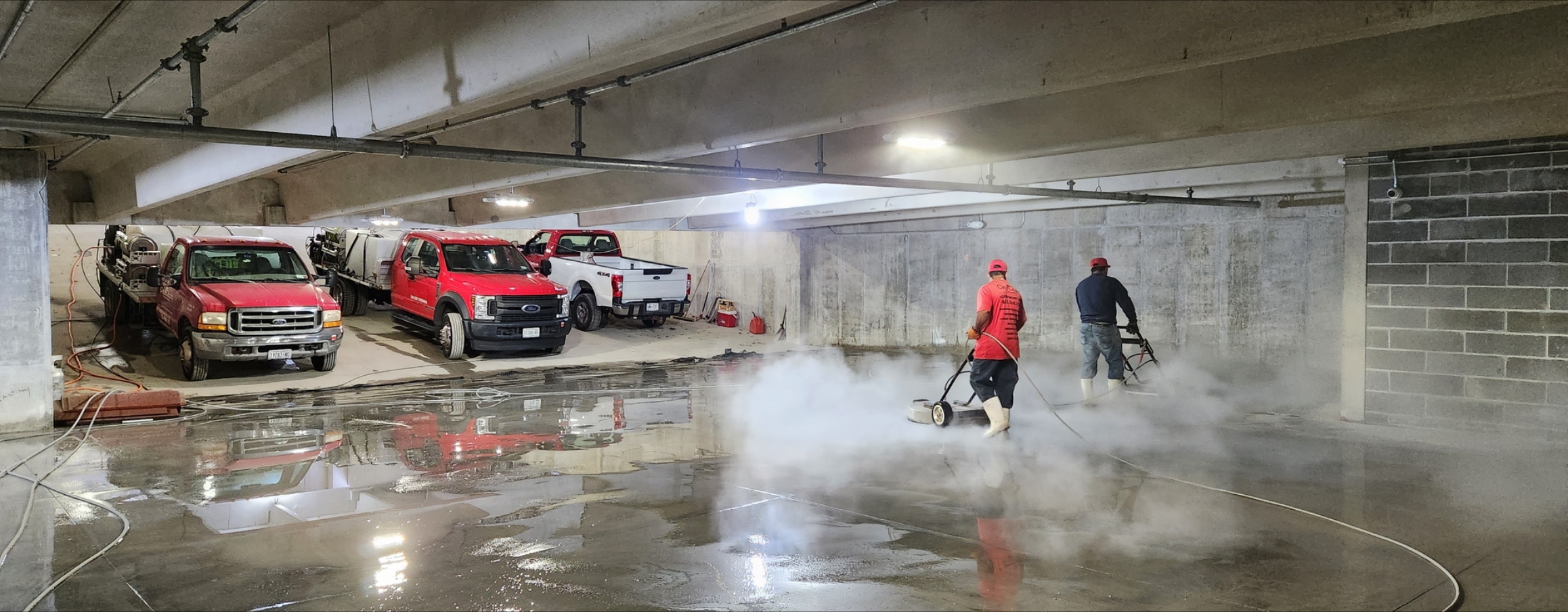
Structural integrity might not be the first thought when coursing through a dirty parking garage, but it’s something to consider. The short of it is that a properly cleaned garage—emphasis on properly—ensures that concrete realizes its full lifespan. And one need not be claustrophobic to want overhead slabs of concrete to stay in place.
Failure of tons of concrete obviously constitutes an undesirable outcome. Yet, there are also quieter sorts of unwelcome events.
“Oil comes from vehicles and puddles in the middle of each parking space and can be tracked with foot traffic, leading to slip and fall hazards,” says Mike Dingler, owner of Firehouse Pressure Washing LLC in Peachtree City, GA. When a garage user is injured, the garage owner is impacted.
“Oil and dirt can affect the coefficient of friction of the concrete in the parking garage, leading to a potential lawsuit if left unchecked,” explains Dingler. “Coefficient of friction is a measurement used in insurance to rate the ‘slipperiness’ of a surface, and it is the property manager’s responsibility to ensure the coefficient of friction on all walking surfaces meets insurance requirements.”
What’s the frequency of cleaning required to keep a walking surface safe? “Parking garages should be cleaned as often as needed to prevent dirt and oil buildup,” says Dingler. “Different geographical locations can lead to a variety of contaminants, such as sand and dirt in dry regions and sand, dirt, and organic growth in humid regions.”
There’s a simplicity to the structure of parking garages, but cleaning them can be complicated.
“Many factors contribute to the complexity of cleaning parking garages,” says Dingler. “The work is usually performed when the garage would be most empty.”
Dingler explains that for a commercial garage few vehicles will likely be present at night, whereas a residential garage would be just the opposite; and optimal logistics may require closing one level at a time, moving vehicles, or both.
The closure of a level and relocation of vehicles also facilitates entry for sweepers, which may be used prior to washing. Once water enters the picture, a contractor must be fully compliant with regulations for handling wastewater that contains oil and other residues.
As for tool of choice, Dingler likes surface cleaners. “Surface cleaners are a go-to for any garage; the bigger the better.”
Thirty-Six Years of Experience
Paul Laramee, the owner of Exquisite Finishes in Warwick, RI, completed his first parking garage contract for a municipal building owner in 1989, the same year he launched his business. Today most of his work is commercial with only about 10 percent residential.
“Most of the garages we do are twice a year,” says Laramee. Typically, they are jobs obtained by responding to an RFP [request for proposals].
Laramee says he likes the RFP process, which may put his company in contention with six or so other bidders. He appreciates the process because the owner states what’s expected. In ideal cases, written expectations are amplified during a walk-through.
“I like the walk-through. You can see the obstacles like drainage and pitch,” says Laramee. It’s also a good time to ask questions, too, so that the response to the RFP is realistic.
With any project, Laramee begins with mechanical sweeping. “You want to pick up all the dirt; otherwise you are just pushing mud.”
Requirements for wastewater can vary. Some garages have a drain that can be used. Others have drains that must be covered so that no sand or silt enters them. Some garage owners want all the water picked up.
Laramee has been on the board of directors for the PWNA (Power Washers of North America) for more than a decade. And he’s happy to field questions from fellow contractors, which he often gets from states as far away as Florida and Texas.
It’s the details that matter when planning the cleaning. For instance, an awareness of height restrictions is a must, explains Laramee. A six-foot nine-inch clearance may actually be only a six-foot six-inch clearance in some spots because of ancillaries like hanging power strips and camera systems.
Underground parking garages require special attention to exhaust and ventilation. If hot water is used in the semi-confined space, caution must be taken so that the heat does not set off sprinkler systems or alarms.
Vexing issues vary with the structure of the garage. Above-ground garages built with slabs and deploying expansion joints pose different challenges than underground garages where concrete was poured, explains Laramee.
A pressure washer is Laramee’s tool of choice. “But every garage is a little different. It all depends on what kind of equipment I can get in.”
Care in all things applies. That includes keeping water away from elevators and at least five feet away from doors, says Laramee.
Moreover, it’s not just about cleaning. Snow on top levels of above-ground structures must be removed for safety.
Garage owners often contract with outside companies for garage management. A contractor who develops a relationship with a management company may secure more work. And it’s possible to contract for add-ons, such as concrete sealing and line striping.
Whichever approach a contractor takes to cleaning, there is one constant. “You need a lot of water flow,” says Laramee.
Tool Choice
“A proper-sized surface cleaner is always a good choice to accelerate cleaning and yield a great appearance,” says Bruce Tassone, president of HydraMotion Cleaning Systems in Pottstown, PA. “A large surface cleaner is helpful, but a contractor should check that their pressure washer flow is sufficient and that there is enough water available to drive the surface cleaner.”
The large surface cleaner is one choice. “Another good option is to use environmentally safe degreasers to pretreat any heavily stained areas or grease buildups,” explains Tassone.
Balance in all things, including the frequency of cleaning parking garages. “The goal is to keep a proper appearance and not allow buildup to accumulate so fast that cleaning becomes more difficult in the future,” says Tassone.
It’s worth repeating that cleaning promotes a safe environment. Yes, cleaning eliminates slip and fall hazards. It also ensures that garage users are not so distracted by grime, startled by rodents, etc. that they walk into a vehicle.
“There are two significant challenges in cleaning a parking garage,” says Tassone. “One is having sufficient water or a water source available. There must be sufficient water available to drive the pressure washer, particularly when using multiple crews and equipment.”
The second challenge also relates to water. It is meeting local regulatory requirements for water discharge. “The contract cleaner should always check to ensure what the local requirements are,” says Tassone.
“All parking garages present unique challenges,” explains Tassone. “One site may have limited access; another site may have multiple levels.”
Completing the job on time and within budget begins with planning, says Tassone.
Learning
Experience is a good teacher. Usually, however, learning from someone who possesses extensive experience is better.
John Tornabene, owner of Clean County Powerwashing in Kings County, NY, brings deep experience to the classes he teaches. In October he offered such a class at the CETA PowerClean® 2025 in Reno, NV.
In class Tornabene covers the full array of relevant topics: how to get jobs, how to clean efficiently, and how to earn a good income. Obtaining excellent results for customers is only half the equation for a contractor. The other half is ascertaining that a profit is made.
The combination of sweeping and washing, if done on a regular schedule, can lengthen intervals between washes. “A parking garage should be swept at least every other month and power washed every one to two years,” says Tornabene.
“Parking garages must be power washed to preserve the integrity of the concrete,” says Tornabene. If tracked-in salts are not washed away, they will begin to soak into the porous concrete and eventually attack the rebar.
Disintegrating rebar leads to cracks in concrete. A crack in a concrete sidewalk is one thing; a crack in an overhead concrete slab is another thing altogether. Over time, chunks of concrete could fall, or in the worst cases a garage could collapse.
“The most difficult and dangerous part of power washing a parking garage is if it’s done while the garage is open,” says Tornabene. In some cases, such as hospital garages, there is no alternative to working while the garage remains open.
“The most challenging garages to clean are the ones that are below the surface,” says Tornabene. “If the exhaust fans aren’t up to par, then the trucks have to be kept outside so workers are not at risk for carbon monoxide poisoning,” he says.
In the tool-that-works-best category, Tornabene puts riding surface machines. The machines speed up the cleaning process, and the operator doesn’t suffer from fatigue.
A formal class such as Tornabene’s gives a contractor the knowledge required to separate facts from sales techniques. Consider on-site drains. Tornabene explains that certain on-site drains can be used for wastewater. With access to an appropriate drain, the contractor need not invest in an expensive, on-site reclamation trailer.
In the end, maintaining a parking garage is about much more than appearances—it’s a matter of safety, liability, and long-term investment protection. Attention to detail, proper scheduling, and the right tools can make all the difference between a clean, secure structure and one that poses hidden risks. For property managers and contractors alike, a well-maintained garage isn’t just a clean space—it’s a sign of diligence, professionalism, and respect for everyone who drives or walks through it.

Current Digital Issue
|
|
Click to read.
|


Go Mobile