
Helpful Equipment Features That Do No Harm
by Diane M. Calabrese | Published March 2026
Access. It’s something to consider when choosing equipment and ancillaries.
The lighter and more agile a machine, the easier it is to maneuver, whether into position or from jobsite to jobsite. Any feature of a machine or ancillary that improves access, including easing the path to the inner workings that must be monitored for routine maintenance, is helpful.
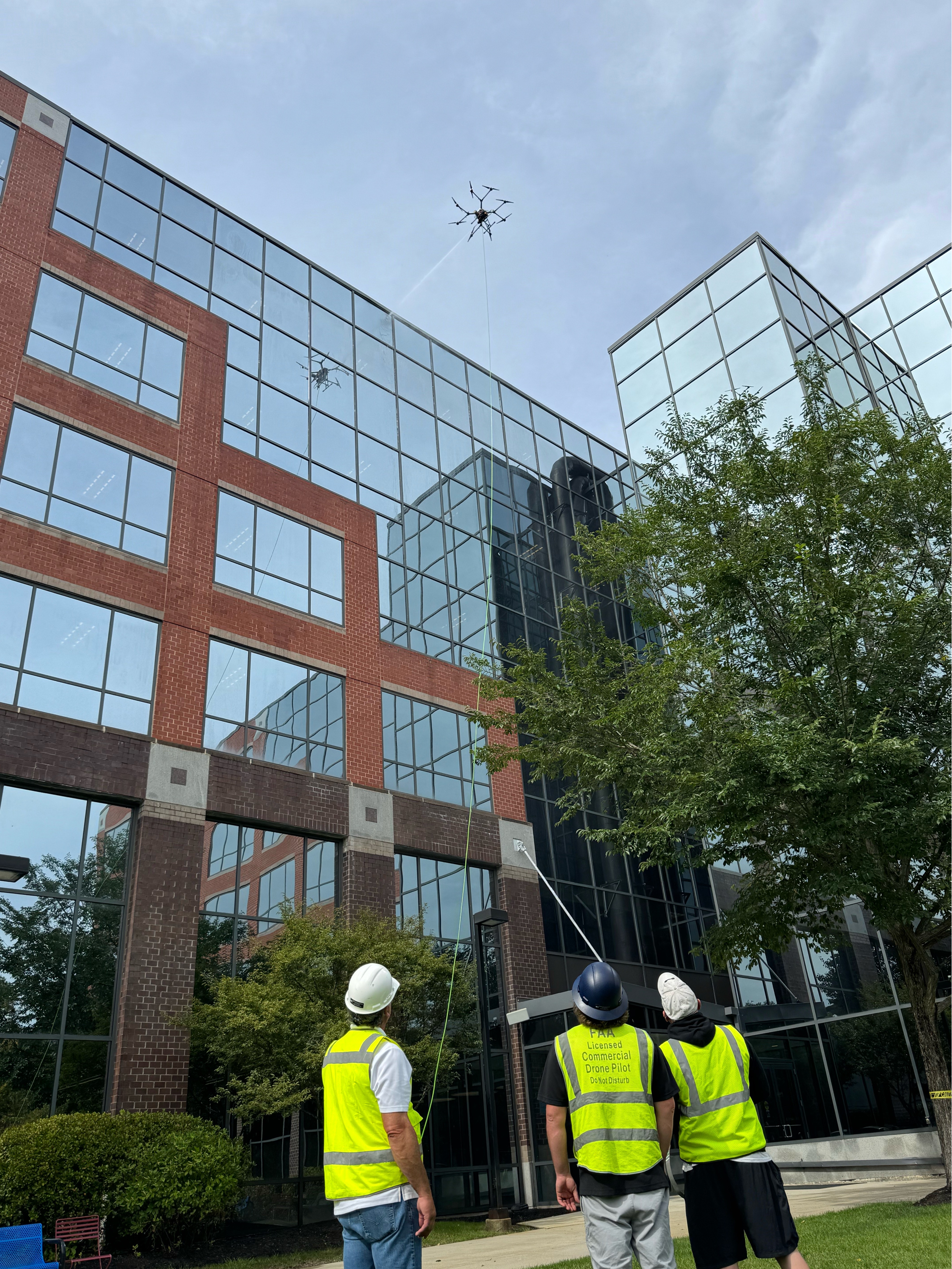
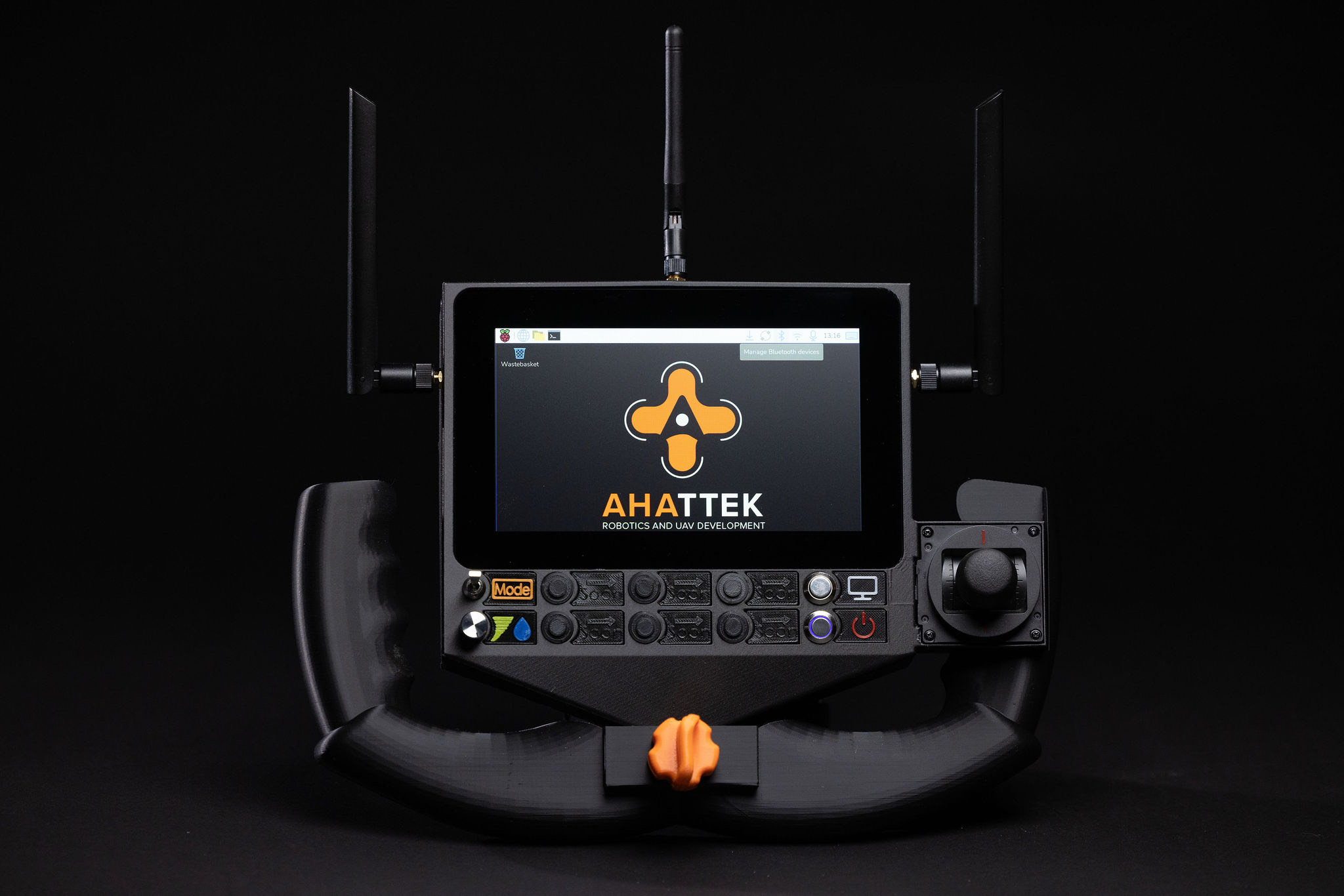
Photo courtesy of AhatTek
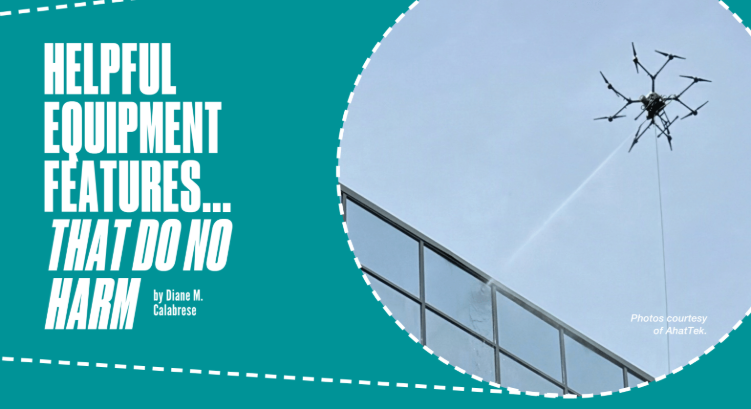
“One of the most overlooked features is equipment that fundamentally changes access, not just efficiency,” says Debbie Cline, the media representative for AhatTek, a maker of wash drones located in Worcester, MA. And she makes a persuasive statement about why.
“Wash drones eliminate the need for lifts, scaffolding, and rope access on most mid-rise projects,” says Cline. “This shift alone transforms project economics.”
When a drone enters the picture, a lift may exit or be subordinated in use, therein contributing a helpful feature to be sure. “When you remove lifts, you’re not just saving rental costs; you’re reducing setup time, simplifying logistics, and freeing crews to work more buildings in less time,” explains Cline.
The pluses that accrue to contractors who adopt wash drones are many. Cline cites the ability to complete projects faster with a more efficient deployment of personnel, resulting in higher throughput and stronger return on investment (ROI).
All good results from an airborne, hands-off piece of equipment. Wash drones accomplish two more significant things. “They take people out of harm’s way,” says Cline.
Drones may aid recruitment. “Operating advanced equipment from the ground is far more attractive to younger workers and helps contractors recruit and retain talent in a shrinking labor pool,” says Cline.
Components of the drone itself continue to be improved in helpful ways. “The introduction of movable nozzle technology, which
has been a major step forward for the industry, is a helpful feature that we’re especially proud of,” says Cline.
An operator no longer needs to land the drone to change between up-facing and down-facing nozzles or reposition the drone to compensate for the nozzle in place, explains Cline. With fewer landings, time is conserved, battery life is extended, and cleaning coverage per flight increases.
Cline’s company is actively engaged in bringing more helpful features from the contractors’ wish lists to reality. Among them are better visibility and even more ability to adjust when the drone is airborne.
Diagnostics
Eyes on the future but feet on the ground. Even as innovators offer new features, it’s a must to keep in mind the utility of helpful time-tested components and machines.
Scott Myers, product manager at Veloci Performance Products in Burnsville, MN, points us to the pressure gauge. “One of the most critical diagnostic features that remains underutilized by many contractors is the pressure gauge,” he explains.
A pressure washer operator gets a good indication of the overall health of the system by monitoring the pressure gauge, says Myers. “Accurate pressure data enables operators to identify inefficiencies, diagnose developing faults, and prevent component failure or unsafe operating conditions.”
Prevention is always better than intervention, and the helpfulness of the pressure gauge ought to be better known.
Why does the pressure gauge get overlooked? “Pressure washers are commonly selected based on their advertised gpm and psi ratings, with the assumption that these outputs are consistently achieved under operating conditions,” explains Myers.
But the assumption cannot be supported. “In practice, system pressure and flow are dynamic and influenced by a wide range of variables,” says Myers.
What can cause deviations from rated performance? “Pump wear, unloader valve malfunction or mis adjustment, restricted inlet supply, clogged inlet filters, improperly sized or low-quality nozzles, component mismatching, hose length, and elevation above sea level can all contribute to them,” says Myers.
Get to know the pressure gauge. It’s not a one-size-fits-all feature.
“Pressure gauges are available in multiple configurations, including threaded valve-cap mounts for direct pump-head installation, quick-connect fittings that allow placement at various points downstream of the unloader, and permanent panel-mounted installations,” says Myers. There’s good reason for the variety.
“Each configuration serves a diagnostic purpose depending on the system layout and testing requirements,” explains Myers. In terms of layout, placement of the gauge matters.
“For the most accurate pressure readings, the gauge should be installed as close to the pump as possible,” says Myers. “Optimal locations include the pump valve cap or immediately downstream of the unloader.”
Thanks to quick-connect gauges, an operator need not commit to a permanent place for a gauge. “Quick-connect pressure gauges offer additional versatility,” says Myers.
The quick-connect feature allows “technicians to relocate the gauge between machines or install it at the end of the hose to quantify pressure loss across hoses, fittings, and accessories,” explains Myers.
A pressure gauge may be a feature so familiar it gets overlooked. That would be a mistake.
“Regardless of whether the system is configured for pressure washing or soft washing, routine monitoring of operating pressure is essential for maintaining peak performance, ensuring component compatibility, and reducing mechanical and safety risks,” says Myers. “Given their low cost and diagnostic value, pressure gauges should be considered a standard component of any professional washing system.”
Simplification, Speed, and “Someday”
Any feature that simplifies the work of a contractor or equipment operator merits the label “helpful.” Thus, equipment owners should work with their distributors to be sure they have in place the latest features that ease care and maintenance.
“Having an easy winterization system installed on equipment is a helpful feature,” says Dennis Black, president of McHenry Pressure Cleaning Systems Inc. in Frederick, MD. “In our climate winterizing equipment is essential.”
Such an installed winterizing system is “invaluable” because it makes winterization an efficient and undemanding process, explains Black. “We see a lot of equipment purchased from other vendors that does not come with such a system.”
Contractors who do not have the installed system may incur freeze damage to their equipment. That’s expensive to correct.
Distributors can discuss with contractors how, when, and where equipment will be used. With that information they can recommend features.
For instance, machine owners can deploy a system to reduce the likelihood a pump system will overheat due to excessive bypass time, such as the unit running without the trigger gun being pulled. “We install a cool bypass system on most of our portable, contractor-based equipment and systems,” explains Black.
The last several years have seen ground-based technological changes contributing to jobsite outcomes as assuredly airborne features have. The mix is a good one.
“Higher flow rates—gpm—have increased productivity,” says Black. The higher rates allow contractors to wash faster. “Units being offered in flow rates of 8 to 11 gpm have offered contractors more cleaning capabilities.”
Black says that contractors do have wish lists (like all of us). For example? “They are interested in using electronic fuel-injected engines.”
For the immediate future, Black does not see the implementation of such engines. The cost is slowing down their embrace by manufacturers.
Telematics
In between the someday and the present, there are plenty of ideas for features in all stages of being converted from planning stage to actualization. Greg Sprunk, president of Superior Cleaning Equipment Inc. in Phoenix, AZ, has one on which he is keen.
“Telematics for contract cleaners as well as businesses that have stationary units is something I’ve been asking for over the last 10 years,” says Sprunk. “Being able to log in and see hours, psi, maintenance reports or times, and things of that nature would be great.”
Sprunk explains that some manufacturers have made some limited releases of the telematics he describes. He looks forward to full digital integration.
Looking at equipment from the perspective of a contractor, Sprunk says that several features come to mind that might be beneficial. A few examples follow.
Belt-driven machines are more heavy duty and have larger pumps for the same gpm and psi capacity, explains Sprunk. “This means larger crankshafts, rods, and just more industrial equipment in general.”
The belt-driven machines “spin at sometimes half the rpm that their direct-drive counterparts do and are sometimes twice as large,” says Sprunk. He adds they are a good investment in either hot or cold-water versions.
”Another feature is machines with120 V burners, which require a generator,” says Sprunk. “Not only are the 120 V burners more industrial, but also they are less expensive to maintain in the long run.”
Sprunk says that although global burners that run directly off a rectifier on the battery are less expensive to purchase, the parts are more expensive. And he emphasizes the importance of comparing helpful features in context.
A feature may be a perfect fit for one setting but not for another, explains Sprunk. Similarly, it may be a match for a cold-water machine but not a hot-water machine.
Before choosing any feature, evaluate carefully. Good options in some circumstances, such as automatic start-stop or delay shutdown, could be problematic in others. (A hot water machine that shuts down while the coil is hot could be destined for trouble.)
Best guide to a helpful feature: No harm done.
Current Digital Issue
|
|
Click to read.
|

Go Mobile