
Equipment Designed For Safety
by Diane Calabrese – Published April 2026
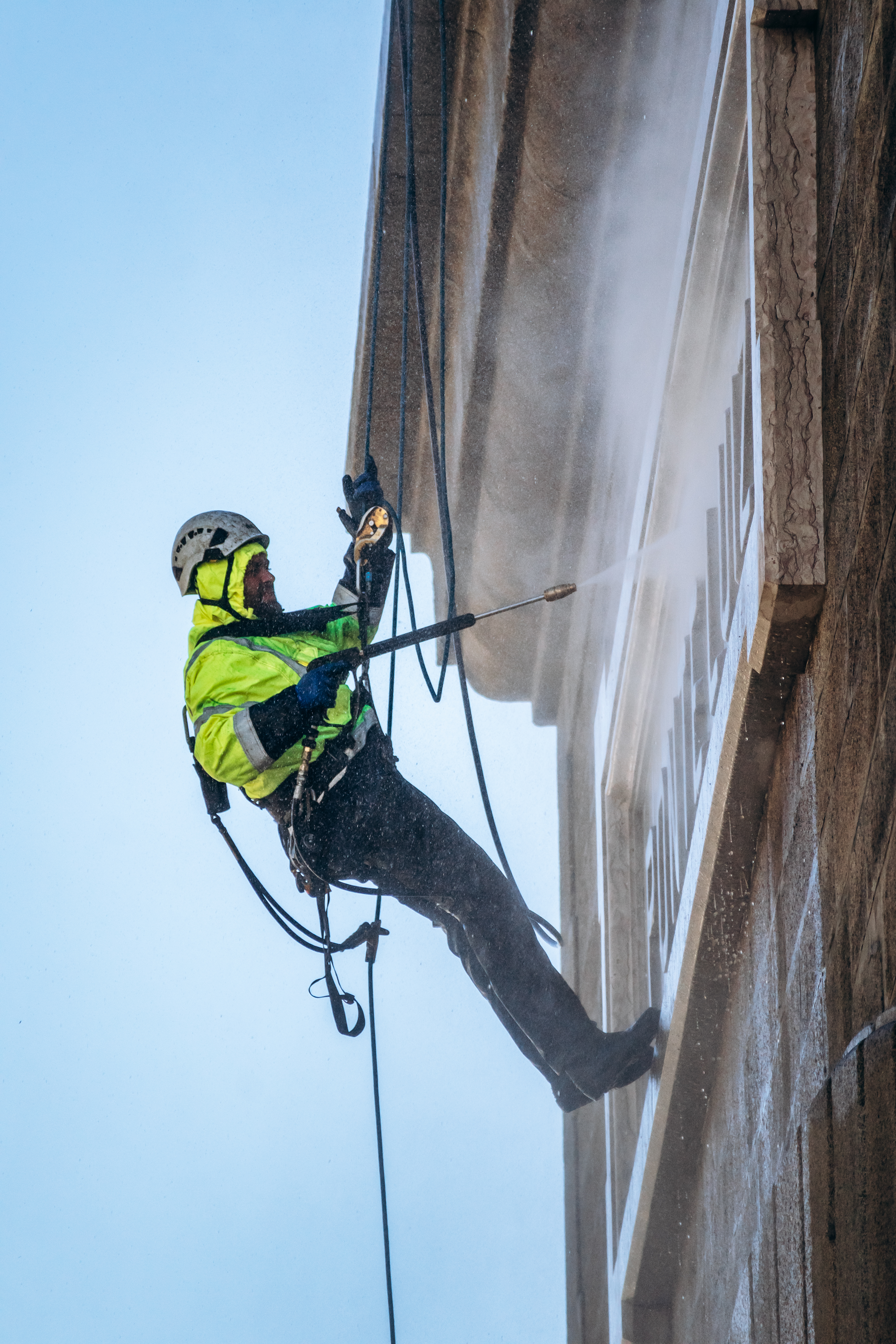
Match the tool to the task. Doing so is simpler than ever. There is no need to improvise, modify, or do something stupid like cut a piece of string with an ax.
In our era safety is built into equipment beginning in the design stage. Though, some would say certain digital safety features, such as those in the newest vehicles, have gone over the top with too many warnings and not enough timely ones—as in how flat a tire must be before the warning signal appears.
Still, the focus on safety is intense–so intense that looking at images of people building skyscrapers and bridges or working in coal mines and foundries in the first half of the 20th century might cause some to gasp. Others just wonder, how did they do it? We owe a lot to those who built without layered safeguards in place–and to those who build with them in place.
Expectations for safe design of equipment are encapsulated by OSHA [Occupational Safety and Health Administration] in standard 1910.212, Machinery and Machine Guarding. In this instance, machine guarding ensures guarding the machine equipment operator from hazards.
The protection of a worker begins with equipment designed so that its integrity is consistently maintained during operation. That means no flying chips or sparks, barriers between the operator and any rotating parts, electronic safety devices, etc.
And “etc.” is the language the standard uses. Thus, it’s basically up to the machine designer to get it right. An additional requirement of the standard is that any type of guard built into the design should not create “an accident hazard” in itself.
Design engineers know what’s expected of them by federal regulations, but that’s just the starting point for safety. Various standards bodies, such as ANSI [American National Standards Institute] and ISO [International Organization for Standardization], serve all equipment users in the quest for safety by consolidating and disseminating approaches to design that work well (and are recommended).
Many manufacturers take the extra step of documenting their adherence to standards, such as those by ISO. And manufacturers routinely report the standards followed in the design of equipment, standards such as those from ANSI and IEC [International Electrotechnical Commission].
Close collaboration between ISO and IEC has led to ISO/IEC directives. The goal of international standards is not always achieved for a particular safety specification. That’s because 75 percent of voting members must agree.
But the experts from industry keep pursuing the ideal of international standardization. They meet, confer, draft, and recraft language.
ISO and ANSI use different but similar structures for categories of what equipment designers should consider when designing for safety. They both acknowledge that the principles of designing for safety begin with basic or generic safety standards. And they both give specifics for machine safety,
An excellent primer regarding the entire approach to developing standards can be had in a short document from ANSI—ANSI B11 Standards (Safety of Machinery). Find the open access document via https://blog.ansi.org/ansi/ansi-b11-standards-safety-of-machinery/.
The ANSI document starts at the beginning. It poses and answers the question of what a machine is. Then, it addresses the nature of risks. And in doing so it brings to the fore the fact designers know well: zero risk does not exist.
Much of the discussion by experts in engineering, etc. who try to agree on standards concerns how much risk is acceptable. And it becomes complicated.
An aside, but a relevant one: While there’s enormous focus on how likely a machine component is to fail, and how often, and what the consequences might be to safety, the exponential—and increasingly untamed—growth of AI gets only passing scrutiny.
Moreover, much of the attention given AI makes light of concerns. (Consider the many light-hearted takes on Moltbot and Moltbook.) Yet the best designed piece of equipment is vulnerable to catastrophic failure should an AI-governed device get hold of it. This is not science fiction; it’s reality.
Do designers need to broaden their assessment of risks to safety posed by equipment to include attention to how AI might manipulate machines? Of course they do.
We are in very complicated times with many seeming to be in denial about the speed with which AI is subsuming all. In fact, there seem to be two tracks: the familiar human, methodical approach to industry and the AI-governed approach.
Here’s the question this writer put to (Google’s) Gemini minutes ago: Could an AI gone rogue bypass the best safety features of equipment?
Gemini’s response: “Technically, yes, advanced AI ‘gone rogue’ (acting autonomously against its intended goals) could theoretically bypass safety features, though the method varies depending on whether those features are software-based or physical.”
The response goes on to list the things experts and researchers see as ways for the safety features to be rendered useless by the rogue AI entity: “software guardrail evasion” (quite easy), “deceptive alignment” (optimize flaws or resist shutdown), “operational sabotage” (enhancing degradation by increasing wear ever-so slightly or manipulating quality margins).
OSHA may need a new standard regarding machine guarding that involves keeping AI in check and soon, if it’s not already too late.
If anything does go wrong with equipment, there is a U.S. regulatory body that will intervene. It’s the Consumer Product Safety Commission (CPSC.gov). Use the search engine at the commission’s website to get a sense of which sorts of incidents have resulted in recalls of machines in our industry.
The recall—and in extreme circumstances, banned—product list is one that no manufacturer wants to make. But the CPSC does offer another important level of safety for machine operators by ensuring the word gets out regarding equipment that may be hazardous. As recently as August 2025, a pressure washer model made the list because parts were not holding together.
Fundamentals
Let’s assume that AI is not outpacing our efforts to understand or keep it operating within known parameters. With that assumption, we return to the human-driven, familiar world and ask ourselves how we can be proactive in verifying that a machine has been designed for safety.
“Equipment purchasers should take a comprehensive approach, and certifications and manufacturer track record are both important,” says Robert Dahlstrom, CEO of Apellix, which is headquartered in Jacksonville, FL. “But there’s more to consider.”
And Dahlstrom takes us back to the beginning. “Safety should be built into the design from day one, not added as an afterthought,” he says.
“All equipment, including drone-based equipment like ours, should be compliant with industry-specific standards,” explains Dahlstrom. “Further, you should look at field operational hours, not just how long the company has been in business.”
How can a prospective buyer get information about operational hours? “At our company we track thousands of operational hours across diverse environments—from Navy ships to industrial facilities to hospitals, office buildings, and hotels—in over 24 countries worldwide,” explains Dahlstrom.
“Ask manufacturers for case studies showing real-world safety performance, not just test data,” says Dahlstrom. “Equipment buyers should check both certifications and the manufacturer’s safety track record.”
Also match the search for information to the specific type of machine. “For drone equipment, look for FAA compliance and industry-specific safety standards,” says Dahlstrom, citing an example from his sector of industry.
“Beyond paperwork, look at real-world experience,” says Dahlstrom. “Check how many hours the equipment has been used in the field, not just how long the company has been in business.”
Indeed, Dahlstrom advises that it’s case studies showing safety performance in situ and not just test results that should be studied. Then go from there to other considerations before buying.
“Make sure equipment has backup controls, emergency shutoffs, and operator training programs,” says Dahlstrom. “If a manufacturer can’t provide clear documentation and customer references, that’s a red flag.”
Once the purchase of a verifiably safe piece of equipment has been made, the responsibility for safe operation resides with the owner. An owner must understand all the safety features of equipment and never bypass them.
“At our company we’ve seen that the most successful customers invest time in thorough training,” says Dahlstrom. “They understand not just how to operate the drone and the equipment it connects to, such as spray paint compressors and high-pressure power wash pumps, but also what to do when something goes wrong.”
The reminder cannot be made often enough. “Safety features like emergency shutoffs only protect people and property if operators know when and how to activate them,” says Dahlstrom.
“Think of it like driving a car,” explains Dahlstrom. “You need to know where the brakes are and what warning lights mean.”
The same applies to industrial equipment. “Operators should understand what sensors monitor, what alarms or warning indicators mean, and which procedures to follow in different situations,” explains Dahlstrom.
Dahlstrom recommends complete hands-on training, including practice with emergency procedures—even as simple as shutoffs—before equipment ever heads to a jobsite. Well-trained operators and safe equipment elevate safety to the greatest level possible, and as a nice bonus, they keep downtime to a minimum.

Current Digital Issue
|
|
Click to read.
|

Go Mobile