
Current Digital Issue
|
|
Click to read.
|


The ABCs of Hearing Protection, Part 1
By Gary Weidner / Published September 2014
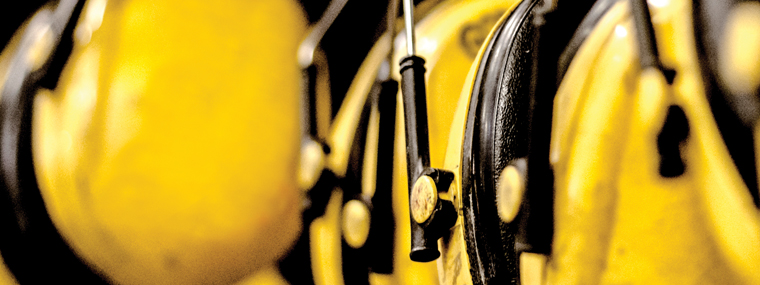
Editor’s Note: This article was initially published in the September 2007 edition of Cleaner Times. Part II will be published in the October issue of Cleaner Times|IWA.
If you start to regularly lift heavy things as part of your daily work routine, your body will adjust by developing larger muscles. If you start to do rough work with your hands, they are likely to adjust by developing calluses as a protective measure. The pupils of your eyes adapt to a wide range of light levels by automatically changing size to control the amount of light entering the eyes.
Those are only three of the many mechanisms by which the human body adapts to its environment. Because we are so used to the adaptable nature of our bodies, we may tend to overlook—or perhaps not even be aware of—the fact that our sense of hearing has no way to adapt to or cope with loud sounds.
Putting it bluntly, the American Academy of Otolaryngology says on its website, “There is no treatment—no medicine, no surgery, not even a hearing aid—that completely restores your hearing once it is damaged by noise…
“When noise is too loud, it begins to kill the nerve endings in the inner ear. As the exposure time to loud noise increases, more and more nerve endings are destroyed. As the number of nerve endings decreases, so does your hearing. There is no way to restore life to dead nerve endings; the damage is permanent.”
Regulations
Hearing loss is painless, and it usually develops gradually over a period of several years, so the odds are that you wouldn’t notice it until serious damage had been done. Therefore, OSHA has in place a Hearing Conservation standard for the workplace (CFR §1910.95).
The OSHA standard says, “Employers shall make hearing protectors available to all employees exposed to an eight-hour time-weighted average of 85 decibels or greater at no cost to the employees.” [1910.95(i)(1)] We will discuss decibels later in the article.
OSHA takes this matter seriously. Hearing protection manufacturer Bacou-Dalloz analyzed OSHA compliance actions for a five-year period and found that more than 10,000 violations were cited, with accompanying penalties exceeding $7.5 million. Violations were grouped into the following areas:
• Lack of or inadequate hearing conservation program;
• Noise monitoring;
• Audiometric testing;
• Hearing protectors;
• Employee training;
• Record keeping.
The last five items in the list above are actually the components of a good hearing conservation program.
Does Your Company Need a Hearing Conservation Program?
It’s unlikely you want to tie up time, effort, and expense for a regulatory matter if it isn’t applicable to your operation. Terms like audio-metric testing and noise monitoring seem to connote hassles and cost. On the other hand, if an employee develops job-related hearing loss and your company did nothing to prevent it, your company could be in for problems.
Fortunately, even the government doesn’t expect every employer to automatically establish a program and conduct tests. The National Institute for Occupational Safety and Health (NIOSH), a part of the federal Centers for Disease Control, offers the following tip for a common-sense check to see whether a hearing program is needed.
“There are two rules: First, if you have to raise your voice to talk to someone who is an arm’s length away, then the noise is likely to be hazardous. Second, if your ears are ringing or sounds seem dull or flat after leaving a noisy place, then you probably were exposed to hazardous noise.”
Go Mobile