Current Digital Issue
|
|
Click to read.
|


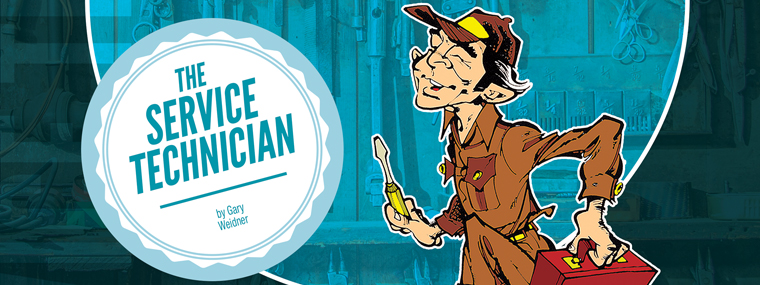
Service Technician Training: The Service Technician
By Gary Weidner / Published June 2015
Editor’s Note: This service technician training series was published previously from September 2008 through June 2014 in Cleaner Times| IWA. It is being republished with the recognition this material is not exhaustive of the subject at hand, but rather to present to new servicepeople an all-important fundamental understanding of how things work.

I am not very comfortable writing in the first person, but it seems appropriate to start out with a little background. When I started out as a trainee pressure washer mechanic in 1989, one of the first surprises was that there was very little training material available for the novice mechanic. Various pressure washer manufacturers did offer “schools” to teach about their products, but there was no source of general, across-the-board knowledge. You learned by on-the-job training.
Things change over time, but not always the things we’d like to see change. From what I hear, there’s still no comprehensive training material for budding pressure washer mechanics, and no trade school where one can learn the pressure washer service trade.
Deep down, we all want to do something useful in life, so as my pressure washer mechanic experience accumulated, in 1992 I began writing a series of Cleaner Times articles to pass along the knowledge. The articles marked the beginning of a new department in the magazine called “Service.”
The need for information and training material still seems to exist, so Cleaner Times|IWA has decided to update as appropriate and republish the series. The “Service” department of the magazine has grown to include a wide range of topics, so to avoid confusion this series, which is aimed at those who service pressure washers for a living, will be labeled “Service Technician Training.” The original series began as follows:
This is the debut of a new department in Cleaner Times. Its purpose is to try to provide in one place a useful collection of information on troubleshooting and repairing pressure cleaning equipment by:
1. Providing information in the form of pages designed to be removed each month and collected into a “manual;”
2. Providing material useful for both training and reference;
3. Avoiding favoring the designs of any single equipment or component manufacturer;
4. Writing for the serviceperson or trainee.
No single article in this series will neatly fit all of the varied needs and interests of service trainees, experienced service people, service managers, and those setting up new service operations. Our aim, however, is for the collected series to provide teaching and reference information that can complement on-the-job training and manufacturer schools and videos.
A Necessary Evil?
It’s usually necessary to be able to service machines in order to sell them. But as service departments, we often exist as high overhead operations where it can be difficult to recover costs. Hence we’re frequently looked upon as a necessary evil. Yet surely most people in our industry would agree that a high quality, professional service department can provide a real competitive advantage both in selling machines and keeping satisfied customers.
Professionalism
The foundation of a good service department is the serviceperson, and there is more involved in good service than turning wrenches. We all know the admonition not to judge a book by its cover. Yet we also know that people do, in fact, judge very much by appearances! Do you and your tools, supplies, parts, and service vehicle convey a high quality, professional appearance? This critical area depends on YOU; it doesn’t necessarily require a large, big-bucks operation with fancy service trucks and spiffy uniforms.
Suppose you don’t even have a uniform. Is your attire such that when you walk through a customer’s door she/he will see what they perceive to be a mechanic/serviceperson? Or will the customer see someone who looks like they’ve been living in a cave or someone who looks like they just stopped off on the way to a beach party? A good alternative to a uniform might be decent (not faded or torn) jeans, dark blue mechanic’s shirt, and work shoes.
Suppose you don’t have a “real” dedicated service truck—just a pickup to use for service calls, maybe shared with sales people. That will only be a serious drawback if you make it so by simply tossing a few tools and parts into a bucket and hitting the road. More about service trucks later on in the series.
If you’ve been given a title or designation such as service technician, serviceperson, or mechanic, that’s not important either.
What really matters is how you prepare yourself, your tools, and your parts for the call, and then how you conduct yourself on the call. One of the most professional workers I’ve met happens to be a construction laborer. In his conduct and knowledge of the work, his dress, his care of tools, he’s as professional as anyone I’ve seen in any line of work. It’s all in how you approach not just the service call, but your work in general.
This Tip’s for You
The only way all of us can get the most from these service articles is to share! If you’re new, what problems and fears do you have? If you’re a veteran, what techniques have you devised that you’re proud of? What cool time- or knuckle saving tools have you come upon or devised? If we share with each other, we’ll likely acquire more than we give! Remember that when you help someone up a hill, you’re that much nearer the top yourself. E-mail your service tips, gripes, photos of servicing pressure washing equipment, or anything related to servicing pressure washers to michael@adpub.com.
Go Mobile