Current Digital Issue
|
|
Click to read.
|


Power Washer’s Guidebook: Graffiti Removal
Contributor: Doug Rucker, Owner, Clean and Green Solutions, Porter, TX / Published June 2015
Editor’s Note: This entry contains some information from a chapter in the 2002 Power Washer’s Guide-book, “Graffiti Removal,” which was written by Chuck Hoffman of Ultra Wash and revised by Gil Shipshock of Graffiti Solutions, Inc. and Andrew Taylor of American Graffiti.
Geographical Considerations
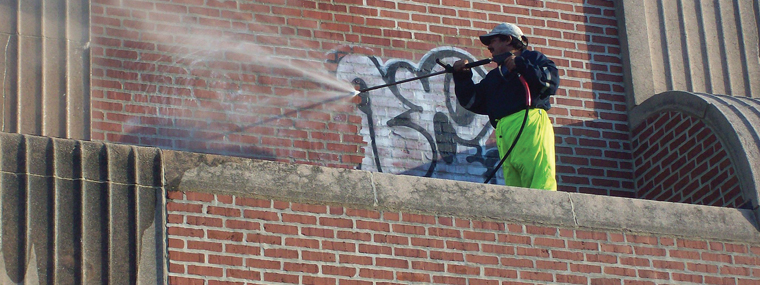
Graffiti appears in all parts of the country. Some of the densest graffiti occurs on bridges, retaining walls, and barriers associated with railroad and mass transit tracks, places where removal has become a low priority.
Typical Job
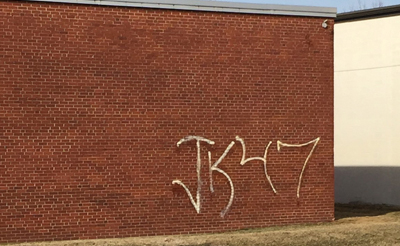
Predominantly, we remove graffiti from hard surfaces, such as brick. The main thing we are looking at is the type of brick. Care must be taken with softer brick. We always do a test application of any chemical.
Techniques that Work Best
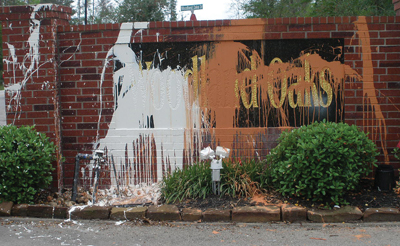
The only product we use is the World’s Best Graffiti Removal System, which offers chemicals such as Bare Brick that are tailored to specific conditions. [Note: The choice of a product is one that a contractor makes based on experience across many years. See also Sidebar (Perspective from the Eastern United States) for another choice/recommendation.]
A hot water pressure washer is needed. Lower pressure and higher flow (eight to ten gpm) do the best job. Dwell time for the chemical remover used must be matched to the ambient temperature and can be considerably shorter on hot days than cold. Always test at each new site and under weather conditions likely to prevail during the work.
Exceptions
Sensitive surfaces, such as wood, require special care. (Overall, we find that harder surfaces are tagged, or have graffiti applied, more often than softer ones.)
If glass is tagged, be sure the tag is a coating and not etched in the surface. Understand the nature of the graffiti before approaching any job. In addition to etching glass, graffiti makers also use everything from felt-tip pens to laundry markers to tag surfaces.
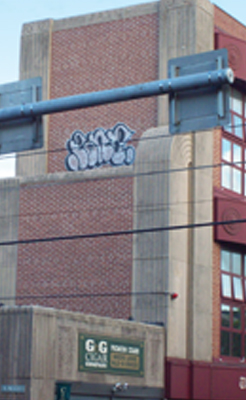
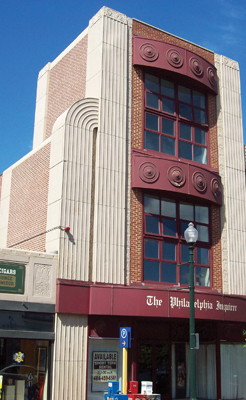
In response to surfaces that are repeatedly tagged, manufacturers have developed coatings to put a barrier between the permanent substrate and graffiti. The purpose of the coating is to make it easier to remove graffiti without damaging the structural component—brick, stone, concrete, etc.—below the coating. For instance, a wax-based protective coating that is tagged can be removed along with the graffiti with hot water alone; it must then be reapplied.
Wet and dry sandblasting, which were used more in the past, still might have a place on certain, difficult jobs. With the attention to all environmental and health regulations, blasting can be used in some settings. Baking soda abrasives are slow acting but powerful, and they have been used in graffiti removal. An advantage of the mechanical methods is that a cold water pressure washer can be used.
Equipment and Supplies
Equipment—hot water pressure washer (1500–3000 psi, capable of 180 F); applicators, such as a sprayer or paint brush, to apply chemical remover of choice.
Supplies—removal chemical of choice (assessed through research and experience and matched to type of surface and marking agent).
How to Bill
Residential and government contract billing are very different. Government contracts are bid out and qualified contractors can respond. From experience, we know how long it is going to take to complete a job and set our estimate accordingly. Before giving an estimate or submitting a bid make sure to assess not only the type of graffiti and surface, but also the access to the site and the availability of water.
Ancillaries
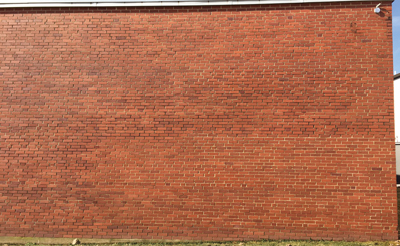
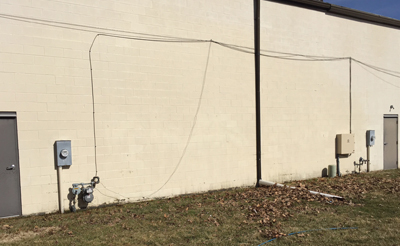
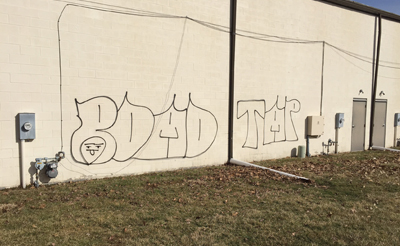
If asked to remove graffiti from a wall, suggest cleaning of the entire wall. There are excellent opportunities for adding cleaning (e.g., home exterior) to the graffiti removal work.
A contractor might also want to suggest the application of a sacrificial protective coating to make any future tagging easier to remove. Similarly, offering painting services to a residential owner can be a good way to add to the scope of a job.
Problem Areas to Avoid
Removal of the graffiti may leave a ghost or shadow of the graffiti. The hint of what was just removed results from unbonded pigment attached to the base material. In time, it will oxidize and disappear.
How to Fix Mistakes
Do an inspection before starting the job to ensure that the substrate is intact. Mark any damaged areas and have the owner agree they are damaged.
Take every precaution to avoid damage to the substrate. If a brick or segment of stucco or other is damaged during graffiti removal, it will have to be replaced.
Make sure the expectations of the customer match the capabilities of the removal method so the customer is not disappointed if a shadow appears.
Doug Rucker is the owner of Clean and Green Solutions based in the metropolitan Houston, TX region. He has been in business for 30 years. He currently serves as president of the UAMCC [United Association of Mobile Contract Cleaners].
Perspective from the Eastern United States
Contributed by Bob Judge, owner, Judge Mobile Wash, West Chester, PA
Whatever the graffiti removal job, the key is to use a method that does the least amount of damage. The main thing with graffiti removal is not to damage the brick—or other substrate.
We have used sand to remove graffiti. For the past 10 years, we have used Tagaway®, a chemical removal product specifically designed for graffiti. There’s a company called Equipment Trade Service in Norwood, PA. We just tell them what we are doing and they recommend a formulation.
We still do a little graffiti removal work for school districts and for Penn DOT. Jobs for school districts are mostly exterior work. School personnel take on restrooms and trash cans, often repainting. The sealed bidding process for Penn DOT is very competitive.
Mass transit in the area, such as SEPTA [Southeastern Pennsylvania Transportation Authority] in Philadelphia, does its own graffiti removal. Some of the most interesting work we have done is removal of graffiti from monuments and plaques in cemeteries.
Bidding a graffiti removal job is very hard. We start by asking the prospective customer to send us a picture. And we go from there.
You really have to know what you’re doing to be successful at graffiti removal. Damage to substrate that must be replaced in large segments, such as stucco, could be costly to the contractor.
Bob Judge has done graffiti removal since the 1970s. He is a member of the PWNA (Power Washers of North America).
Go Mobile