Current Digital Issue
|
|
Click to read.
|


Cleaning Transformers
Published July 2015
The ladder to heaven that Jacob saw in a dream is the stuff of good thoughts. A high-voltage traveling arc, which is sometimes called Jacob’s Ladder, is not.
So serious a hazard is an electric arc that the Occupational Safety and Health Administration (OSHA) has a specific standard (1910.269(1)(6)) for fire resistant (FR) clothing. The “269” standard requires the training of workers in electric arc hazards, and it prohibits the use of clothing that might exacerbate an injury if an arc emerged at a worksite.
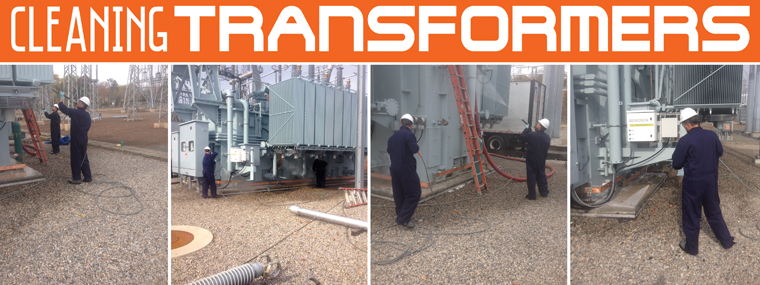
When Jim Pasternak and two of his team members took on the job of washing two new transformers at a substation, they were given FR clothing to wear; and they were under the watchful eye of a representative of the substation the entire time they worked. Pasternak owns NorthEast PowerWashing in Marlborough, CT.
The repertoire of Pasternak’s seven-year-old company encompasses such standard residential and commercial cleaning as house washes, decks, building exteriors, and heavy equipment. But there are several unique projects on the roster, too.
“One interesting job leads to another,” says Pasternak. And the cleaning of the transformers was perhaps the most interesting to date. Pasternak explains he did not go out seeking work at a substation. Instead, he was approached by the company that owns the facility. “They were impressed with our website,” he says. “They contacted us.” It was straightforward from there: “They had us walk the site. I gave them an estimate.”
Although Pasternak had never worked at a substation, he had every confidence his company could handle the job. The clarity of the substation management, particularly “the ease of working with them” contributed to that confidence.
So why did a transformer—two transformers, actually—have to be cleaned? The transformers had recently arrived from China. They had some dust and dirt on them—nothing extraordinary—and they each had some weld marks around their bases.
“This was definitely a unique situation because you would never clean the ones that were already in service,” says Pasternak. Yet even though the transformers were not in service, they were relatively close to transmission lines and other transformers on the substation site. It was a 350 kV substation. The two transformers that were being replaced by the new ones were each 50 years old.
Precautions of many sorts had to be taken. “All the trucks had to be grounded,” says Pasternak. “We had to wear special fire resistant (FR) clothing.” And because the distances between the new transformers and active parts of the station were so small, a lift could not be used.
Technically, the distance between the two new transformers and the live parts of the substation (125 feet and 50 feet, respectively) were great enough to accommodate the required lift distance of 30 feet, but the substation on-site supervisor determined there would be no lifts used.
“We had to be careful of the wind,” says Pasternak. The job had to be done in weather conditions where there would not be a concern about spray being carried on the wind. Even on a still day, the goal was to create no spray. Pasternak’s team used high flow at no more than 500–600 psi with a 0-degree tip and 4.0 orifice. Around the base of each transformer, a turbo nozzle was used.
Having cleaned water towers, Pasternak knew that weld marks were not always removable. Generally, though, as with the transformers (and water towers), the plan would be to paint following cleaning and any residual marks would be covered.
Sodium hypochlorite solution was used as the cleaning agent. Once the weld marks were removed from the base of the transformers, the transformer bases were going to be painted.
Each of the two new transformers—approximately 25-ft. square—had been positioned to the place it would reside at the substation. They had not been filled with oil. It took Pasternak and the two men on his team one day to wash both transformers. The effort required 1,500 gallons of water, and the team hauled in 500 gallons at a time.
“We usually get one or two unique jobs a year,” says Pasternak. For instance every six months, his team cleans a 300-ft. long, 16-ft. wide, slow-moving conveyor. Steam is used to clean the conveyor that moves mattresses. (Over time, debris accumulates on the conveyor.)
When Pasternak spoke with us in early May, he was just about to begin another job for the mattress company owner. He would be cleaning the small filters and grilles that are part of the large, rooftop cartridges tied to the heating, cooling, and ventilation system.
Whatever the project, explains Pasternak, completing it to the owner’s specifications is the surest way to find a path to the next project. And some of the next projects will fit in the unusual category.
Go Mobile