
Cleaning Pool Decks
By Diane M. Calabrese / Published October 2022
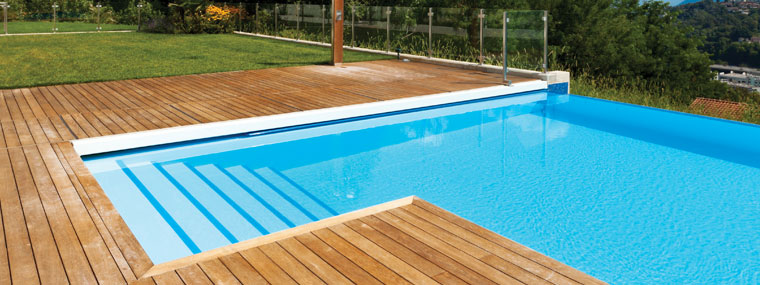
California and Florida lay claim to most of the in-ground pools in the United States—some 40 percent. Yet with more than five million in-ground pools dispersed throughout the country, there are opportunities in almost every locale to provide deck cleaning services. Yes, deck cleaning seems a bit specialized. Shouldn’t it be deck and pool?
Not necessarily. With filtration systems and regularly scheduled chemical tests and applications, pools remain a bit apart from decks.
We all know the poolside rules of no glass, sharp objects, etc. But pool decks accumulate all sorts of things from dirt, dust, and debris to pathogens. What’s on a pool deck will soon be in a pool if the deck does not receive proper attention.
The tricky part of cleaning a deck is to restrict the soils removed. The greatest challenge is “keeping the debris from the cleaning out of the pool,” says John Chatham, professional applicator with Deco Products Inc. headquartered in Denver, CO.
Basics of pool deck cleaning begin with daily pool care. Residential and municipal pool owners can be proactive by daily sweeping.
Standards organizations, such as ANSI, offer prescriptions for pool deck cleaning, including a specific standard for in-ground residential pools. Many municipal and private pool owners establish their own standards. Anyone cleaning pool decks will want to get a copy of all relevant standards and use them as definitive guides.
Residential pool owners should be on a routine schedule of cleaning. “Every six months to a year they should have a cleaning of their pool decks,” says Chatham. “It will help prevent the growth of mold and mildew and keep the substrate looking newer longer.” What’s the definition of clean in the context of pool decks? “A clean pool deck is one without biological growth,” says Chatham.
What about sanitizing? Should it be done in conjunction with cleaning? “When a thorough cleaning is performed, based on the chemicals used—typically sodium hypochlorite—the surface is already being sanitized,” says Chatham.
As for getting the job done, Chatham recommends techniques already familiar to power-washing contractors. “A quality soft wash system and surface cleaners are the best combination of equipment to use to clean pool decks,” he explains.
Some contractors in our industry may venture into the sphere of cleaning pools, but most do not because it’s such a unique niche. Still, it’s important to be able to advise a prospective client on the optimal sequence.
“It’s always best to have the pool cleaned after your pool deck is cleaned,” says Chatham. So, if the customer asks, “Should I schedule a wash prior to cleaning the pool?” be ready to respond.
Forward-looking clients ask a lot of good questions. “How can I help the deck stay cleaner longer,” says Chatham is one such question.
Chatham recommends the use of quality products that go a step beyond cleaning. “Using quality products, like [those from our company], to seal your deck once it’s been cleaned and prepped is the best way to help it stay cleaner longer.”
Poolside View
Drought and fires have affected just about everything in the Golden State over the last several years, and that includes the view from the pool deck.
The major service area for Strunk Services in Vallejo, CA, a company owned by Steve Strunk, is in the North Bay area of San Francisco. It includes the counties of Napa Solano and Sonoma, which are “also known as wine country,” explains Strunk.
“We have had some major fires come through over the last five years,” says Strunk, and their effects naturally figure into the considerations when cleaning pool decks.
In the region where Strunk works, variation is the rule. “When working in the wine country, there are many different conditions—the environment, types of decks, and the materials they are made of,” he says. “There is concrete, sandstone, tile, wood and manufactured planking, and other materials.”
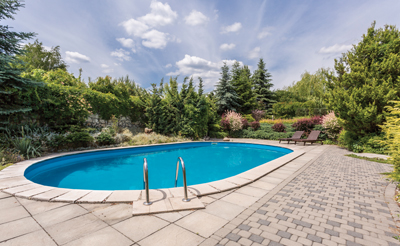
Photo by iStockphoto.com/KatarzynaBialasiewicz
Given the diversity of materials that become pool decks, a contractor must be flexible and do his or her research. “Remember in such conditions that no one cleaner cleans everything,” says Strunk.”
“When you ask what I believe is the optimal piece of equipment, I believe it is the brain,” says Strunk. “Ensure you use the correct cleaner to match what you are cleaning.”
Realize that it may be necessary to use more than one type of equipment and more than one kind of approach. “As far as pieces of equipment, don’t be afraid to ‘mix and match’ your equipment,” says Strunk.
“You may very well have to use a pressure washing machine, a soft wash machine, a surface cleaner, and wands,” says Strunk. “Don’t forget to use the correct nozzles, water pressure, and water recovery equipment.”
Do a careful assessment before taking on a job, says Strunk. It may lead to declining the contract.
“Sometimes you must have the knowledge and wisdom to just walk away from a job,” says Strunk. “After the last big fire, I was asked to bid on a few jobs, and I had to walk away after seeing and evaluating the damage done to the deck area from the melting of patio furniture and embedding the residue into the concrete and delamination of the sandstone.”
In the region where Strunk works, there’s an atypical concern. “Some of the pools are in and around wineries and tasting rooms,” he explains. “Never use bleach around these areas. You can do some serious damage to the wines.”
Again, Strunk emphasizes using one’s head. “Remember to sit down and think it through, plan it through, and work it through. If you can navigate through all the intricacies of what I just mentioned, the actual cleaning is straight forward regardless of the location of the pool and the size of the pool. Finally, ensure your hose wrangler keeps the hoses out of the pool.”
As for the issues that arise, the residential pool deck is not dissimilar from any other space. “Some of the greatest challenges are dealing with the homeowner and their unique requests like don’t hurt the plants, don’t overspray on the poolside furniture, don’t get my outdoor kitchen wet, and don’t get anything in the pool,” says Strunk. “Again, if you can navigate all these things, you’ve got it made.”
Poolside Safety
“No running” is right up there next to “no glass” as a poolside rule. Beyond the big taboos, though, pool owners must consider the unseen sources of risk along the pool deck.
Mold spores and bacteria exploit corrupted surfaces that offer them a substrate. If a tile deck is not cleaned regularly, abrasion from gritty soils may cause enough erosion on a few tiles to allow mold and/or bacteria to take hold and grow.
Deck cleaning (coupled especially with sealing) keeps the surface intact and thwarts growth of organisms that can cause both slick and unsanitary conditions. (Tolerating some algal or mold growth on the siding of a home may diminish the appearance of the structure, but it does not reduce safety.)
Balancing the use of chemicals on pool decks requires full assessment of the substrate. Some pools have either all concrete or partly concrete decks. Using bleach to clean can degrade concrete. Bleach can also break down sealants.
Tile, concrete, wood, or whatever the composition of a pool deck, the manufacturer of the deck substrate will have provided instructions for cleaning. That’s the place to begin when planning an approach.
Pool decks are subject to soiling not only from foot traffic and atmospheric conditions but also from the chemicals that splash from the pool water. Contractors should evaluate pool decks for damage from chemicals, such as chlorine, before providing an estimate to an owner to make certain no preexisting condition is attributed to cleaning.
Many pool decks are angled sufficiently—if almost imperceptibly—that a contractor using a surface cleaner can begin near the edge of a pool and work away from it. Proceeding thus, any runoff into the pool is avoided. (Still, as noted above, it’s best that a pool cleaning be done following a deck cleaning.)
Working at a municipal pool will usually add a layer of record keeping. The when and how of the method
used to clean will have to be documented (signed off on).
Comprehensive cleaning of a pool deck usually includes ridding the surface of spots of rust from corroded pool chairs and the like. Contractors will be likely to reach for something much stronger than soft washing technique. Just be certain to take exacting care when using chemicals like muriatic acid (dilute – 35 to 37 percent – hydrochloric acid). Containment, ventilation, and minimal use are the keys to safety when reaching for this chemical (and many others).
A contractor who becomes proficient in cleaning in-ground pool decks may want to begin to include other water venues that have decks. Among them are spas and recreational water facilities, for which ANSI also provides standards.
As Strunk notes, best practices begin with careful consideration.

Current Digital Issue
|
|
Click to read.
|


Go Mobile