Cleaning Aquariums
A Flow of Opportunities
Contributor: ReBecca Savard, President, Fish Works, Framingham, MA / Published June 2017
Editor’s Note: This entry contains some information from two chapters in the “Flat Surface Cleaning,” 2002 Power Washer’s Guidebook: “Flat Surface Cleaning,” written by Rick Carey, ARK Pressure Washing Company; “Tank Cleaning,” written by Robert L. Moffett, BSEnvE, and James W. Breaux, BSIE, Tank Master/Hydrolance.
Geographical Considerations
As of September 2016, 45 states had accredited aquariums open as public venues, so opportunities to provide cleaning services span the nation.
Typical Job
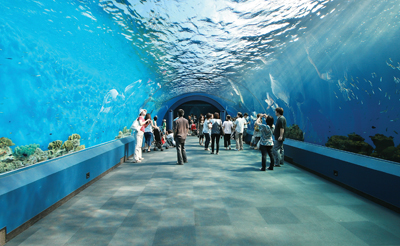
Walkways, overhead glass/glass-like enclosures (popular for letting in natural light), parking lots, and building exteriors present opportunities for contractors. Flat surface and exterior cleaning and graffiti removal follow the same processes as in any setting. Overhead clear-view enclosures are cleaned like windows, either manually with squeegees or with automated systems.
Techniques That Work Best
Parking lots, walkways, and building exteriors are approached in the same way they would be anywhere. Working when the facility is closed to the public provides the most expedient and safest approach.
Exceptions
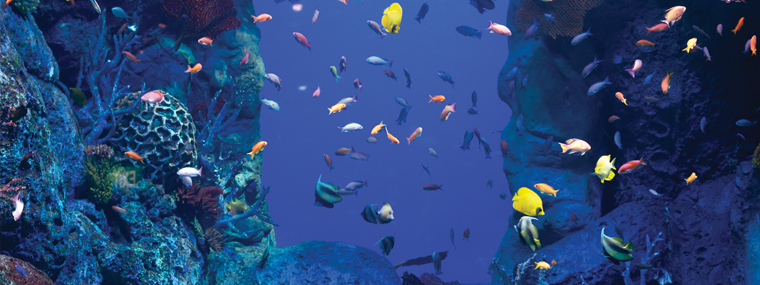
Cleaning large tanks at public aquariums is a specialized endeavor. Wearing scuba gear, specialists enter the tanks to clean the glass and non-living exhibit components, such as faux coral. They use specially-designed vacuums to collect waste they dislodge with manual cleaning (e.g., scraping) or with the use of small jetting tools—their pressure washers. Tanks have exacting, built-in filtration systems that remove particulates and chemicals. Large public aquariums rely heavily on volunteers, even to help with cleaning tank interiors.
Desktop, stand alone, wall divider, and other aquarium types are popular in home, office, and business settings. Across the country, there is a rich niche of providers of turnkey solutions for smaller scale aquariums. The providers install and maintain the aquariums. Fish Works, in the Bay State, is one such provider. It has been in business more than 20 years and has had many interesting days. (See sidebar for an account of one of those days.) Individuals in the private aquarium market bring deep expertise about aquatic life—tropical fish, coral, etc.—to their work.
Contractors will not be able to enter the private aquarium niche without extensive knowledge of aquatic life, particularly tropical fish. They may, however, be able to offer services in cleaning empty aquariums, providing a cleaning service for the structures that house fish, turtles, snakes, hamsters, gerbils, etc.
Equipment and Supplies
Pressure washer and wands for vertical surfaces and for limited flat work, flat surface cleaners for pavement, wastewater collection, warning signs for wet pavement—all the basics on the equipment roster of a contractor will be a fit for the setting. For cleaning clear glass/glasslike walkway covers, contractors may need a lift, and if so, they will have to be certified to work high.
Tools used by those who clean the inside of aquarium tanks—again, a specialized endeavor—mirror those used for tank cleaning throughout industries (breweries to pharmaceutical plants) that use tanks. The tools, of course, run at much lower psi and gpm. For example, SeaVisions of South Florida (Seavisions.com) offers an ‘algae blaster’ that runs up to 150 psi and 1.5 gpm. Automated tank cleaning systems are also used for aquariums.
How To Bill
Public aquariums issue request for proposals (RFPs). Get acquainted with the aquariums in your region and ask how to find out about RFPs issued by private facilities. Government-owned aquariums issue RFPs through the local, state, or federal level that solicits bids, but it can be complicated when more than one entity is involved. For example, the National Aquarium, which is now in Baltimore, MD, issues some RFPs through the state of Maryland. To identify opportunities, get to know the administrator in charge of the aquarium.
 Some aquariums have a special relationship with their commercial members, giving them a direct entry to RFPs. Contractors can learn more about opportunities at aquariums by reading the introductory material at the website of the Association of Zoos and Aquariums (AZA.org).
Billing for privately-owned aquariums will depend upon the work involved. Contractors will have to establish a price to clean empty tanks on a case-by-case basis. In densely populated areas, a contractor might want to invest in automated tank-cleaning equipment for table-top aquariums and then advertise a pick-up (soiled, empty tank), drop-off (clean, empty tank) option to tank owners.
Ancillaries
At a public aquarium, offering graffiti removal (or removal and abatement) as an add-on service to basic cleaning is a good idea. If venturing into a service to clean small aquariums, consider adding repair (sealant, for instance).
Problems To Avoid
Public aquariums focus on education. They put a premium on environmentally sustainable practices. They will expect state-of-the-art approaches to flat surface and exterior cleaning and minimal use of water. They will also expect contractors to comport themselves in a way that meshes with the friendly, especially child-friendly, atmosphere they maintain and to carefully separate work areas from foot traffic of visitors.
How To Fix Mistakes
Whether doing routine cleaning of parking lots and walkways at public aquariums or establishing a cleaning service for empty, table-top aquariums, be sure to agree to expected outcomes with each owner before commencing work.
How Do You Spell Nightmare? “500 Gallons…”
Contributed by ReBecca Savard, President, Fish Works, Framingham MA
It all started so simply—a six-foot standard, 150-gallon fish tank with simple plumbing through the floor, into the basement leading to the filtration unit. Then we turned around and found a new wall, and the tank grew and grew and grew.
The final tank ended up being a 90-inch x 20-inch x 48-inch tank, which created new challenges. The tank was now too long to come off the back of a regular freight truck lift gate. In addition, the client chose to have a large synthetic reef replica, which needed to be built into the tank before the tank finish could be fabricated. This added even more weight to the tank; in the end, it weighed almost a ton.
As you can imagine, this created a logistical challenge. The new length and weight prohibited easy installation. After much searching, Fish Works found an exclusive, specialty moving company with a specially-trained crew. They brought the tank inside the house and got it in place, with the help of our technicians and some heavy-duty lifting machinery.
Once the tank was finally in place, our staff quickly set to connecting the plumbing, filling the tank with water and fish, and creating a stunning aquatic living picture.

Current Digital Issue
|
|
Click to read.
|


Go Mobile