
Get Involved – PWNA Outlook for 2026
by Diane M. Calabrese | Published January 2025
Macro or micro or something in between; which world view applies? It depends.
Most of us develop our outlook by balancing the big picture with our own situation. The quest for equilibrium can lead to reactions ranging from euphoria to anxiety. Either way, we can expend a lot of energy and still not do what needs to be done: something.
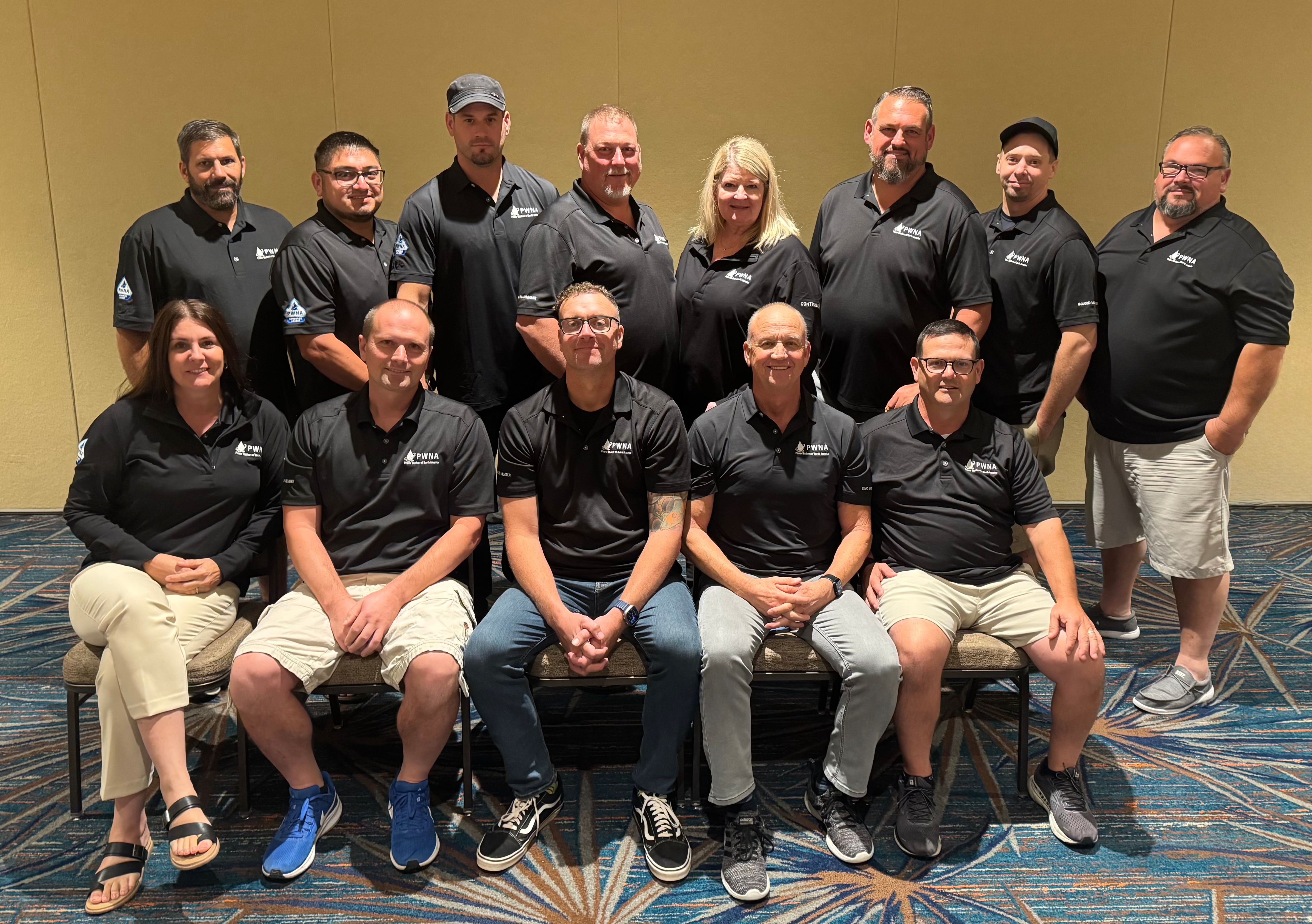
In the context of doing, Clint Reynolds, the president of PWNA [Power Washers of North America] gets right to the heart of the matter. He gives micro advice that applies to the macro world.
“What’s the most powerful thing a contractor can do in 2026?” says Reynolds. “Get involved.”
Naturally, a good place for a power-washing contractor to engage is with PWNA.
Besides serving as the current president of the organization, Reynolds and his wife Jennifer Reynolds lead HydroTech Solutions LLC in Lake Mary, FL.
Sustainable, environmentally friendly methods are built into the protocols that guide Reynolds’s company, which is PWNA certified. With its approach to cleaning, the company exemplifies the balance that can be achieved between running a profitable company and contributing to the community.
Will balance be more difficult in 2026? Almost certainly. Will it be impossible? No.
“Between shifting regulations, economic fluctuations, and emerging technologies, contractors in the power washing industry are staring into a year that feels both promising and unpredictable,” say Reynolds. “At PWNA, we believe that uncertainty doesn’t have to mean instability.’
Obstacles invite us to find a workaround. That’s the outlook that carried Apollo 13 back to Earth and demonstrated how imagination and critical thinking complement each other.
“In fact, with the right tools and community, challenges become springboards,” says Reynolds. He adds that PWNA will continue to help members not just survive in the new year but also succeed.
Those most likely to be able to realize the full benefit of a springboard—and do what 2026 requires of them to succeed—have worked consistently to maintain strength and to be flexible.
Reynolds tells us more about the many ways that PWNA will help its members realize success in the new year. To begin with, the organization will be sure that members have the confidence they need to move across rough patches.
“PWNA is built for moments like this,” says Reynolds. “Our four-pillar foundation—education, networking, compliance, and advocacy—is designed to support contractors when the road gets bumpy.”
There’s nothing like having a built-in repository of knowledge to instill confidence. True, AI assists are as close as a digital device, but for a second imagine a world where devices are all offline.
Need motivation? Recall the way that commander Jim Lovell used a pencil to plot the successful return course for Apollo 13.
“Whether it’s through expanded safety training, regulatory updates, or hands-on learning at conventions and regional events, our organization’s resources ensure that members stay sharp, safe, and several steps ahead,” explains Reynolds. “In uncertain times, access to accurate information and a trusted community can make all the difference.”
PWNA delivers both accurate information and a trusted community all while keeping pace with changes and adapting to meet them.
Reynolds says there is a new initiative from the organization that ought to be watched. It is Enterprise Membership (EM), which was launched in 2025 and is expected to “hit its stride” in 2026.
What’s the essence of the new membership? All-in-one. “This all-in-one membership allows businesses to onboard their entire team under one umbrella, gaining instant access to PWNA’s full suite of power washing and window cleaning certifications, compliance tools, and safety education, including mobile access via the PWNA app,” explains Reynolds. “From daily inspection checklists, a SDS library, and safety manual to OSHA-compliant training, members can empower their teams anytime, anywhere.”
EM melds the objective of ensuring consistency and competency of team members with the power of digital communication. “It’s not just about checking boxes; it’s about building future-ready crews,” explains Reynolds.
New programs must be added in a thoughtful way, and existing programs must be made as strong as possible.
“Leveraging existing programs for growth stands as an ongoing commitment for the organization in the new year,” says Reynolds. “PWNA continues to raise the bar—adding window cleaning training, holiday lighting, and business development courses.”
The business development courses include “new content on marketing, financial key performance indicators such as KPIs, and profitability strategies,” explains Reynolds. “Our existing training is updated on a regular basis with recent updates on house washing, roof cleaning, and fleet washing.”
Learning opportunities extend far beyond the rich course offerings. “Let’s not forget our conventions remain a powerful hub for learning, networking, and vendor partnerships, helping members discover new revenue streams, tools, and innovations,” says Reynolds.
The next PWNA convention will be held in Orlando, FL, February 18–20, 2026. Visit the PWNA.org website to learn more about it as well as the other dimensions of the organization discussed here.
Which is requisite for the other? Staying informed or staying competitive? There is no need to wrestle with such a philosophical dilemma. Staying informed and staying competitive are two parts of a whole.
“PWNA keeps members in the loop through newsletters, social media updates, and committee-driven communication strategies,” says Reynolds. “Whether it’s a new EPA rule, a safety best practice, or an emerging market trend, we ensure that members are always informed and empowered to act.”
The best-informed and best-prepared power-washing professional can still be stumped now and then. Perhaps it’s just the need for a second opinion on an ambiguous local regulation (there are many) or the like.
Simply reach out if in doubt, says Reynolds. “Our board of directors and committees from membership to vendor to education are member run and member focused.”
It’s not only about getting a question answered but also about the community that is formed by members. “You’re never navigating alone,” says Reynolds.
Moreover, Reynolds emphasizes the point in the broadest context in a message to members who feel uncertain about 2026: “You’re not alone, and you’re not without support.”
Uncertainty sometimes seems to be coming from all directions as 2026 begins. Global conflict, vacillating economic indicators, and societal change are a few of the causes.
“PWNA was founded in 1992 to be the backbone of the power washing profession,” says Reynolds. “In good times and tough ones, we stand by our members with actionable tools, strong advocacy, and a growing network of industry leaders who are walking the same path.”
Respond to uncertainty with action. “If you feel uncertain, let it push you to invest in education, expand your network, and strengthen your business with resources that PWNA provides,” says Reynolds.
“Now is not the time to go it alone,” says Reynolds. “It’s the time to grow together.”
Potency of Professional Organizations
Growth during a time when clarity is almost a fantasy might seem a remote possibility. But the prevailing conditions may be those that signal enormous growth.
We sometimes overlook the vast amount of scholarly work that has been done to bring coherence to the vagaries of the world. The utility of professional organizations has long interested scholars, and some of their results should interest us.
For instance, in 1945 Ben W. Miller published a paper titled “The Role of the Professional Organizations” in The Journal of Health and Physical Education (vol. 16 no. 10). The first sentence of his paper contained the well-known refrain that “the future is what we make of it.”
Miller was writing at a time—the year World War II ended—when despite the good feelings over the war’s end, questions about what would happen next in the economic, societal, and governmental realms prevailed. He advocated that the concerned members of society not retreat to individual pursuits but instead join with others who had shared interests. (He recalled the time following World War I when there was just such a retreat, which is a phenomenon many scholars have described.)
Miller believed professional associations were critical to helping society move ahead–move ahead despite the many problems that stirred in the United States at the end of the war.
We cannot attribute all the growth in industry, the supplies of housing, the boost to health and education, etc. that occurred during the 1950s to professional organizations; but the organizations helped focus the energy of their members, and the energy gave a lift to communities.
The enormous benefit provided by professional organizations in the consolidation, distillation, and dissemination of information required by their members can make us forget another large benefit: Professional organizations diffuse knowledge.
The organizations do so by expanding boundaries. Consequently, some scholars label them boundary spanners.
For example, a professional meeting of power washing contractors may include vendors of equipment or chemicals the contractors use. The vendors in turn have their own organization.
A boundary spanned at a conference may ignite a change in a method or a machine that leads to technological advancement and helps society do more with less—water, energy, and time. Professional organizations are potent forces for good. That’s certainty.
Current Digital Issue
|
|
Click to read.
|
Go Mobile