Current Digital Issue
|
|
Click to read.
|

Safety: The Safety Series, Part Two: Step Right Up!
By Terri Perrin / Published May 2015
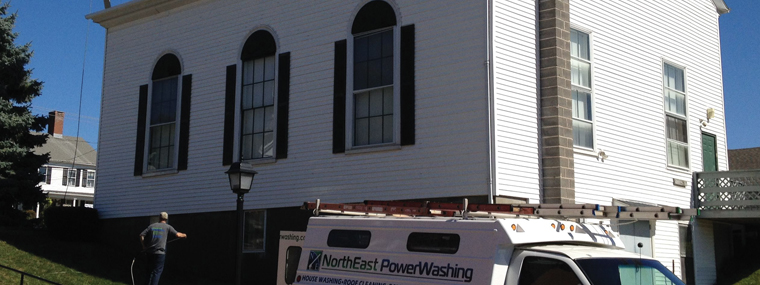
“Before you lift your ladder off the truck or select a potential location to set-up your boom lift, always, always look up! Safely working at heights should start with a thorough site inspection that includes checking for tripping hazards and soil stability on the ground, as well as electrical wires and other dangers above.” These are the wise words of advice from a pressure washing industry professional with decades of experience.
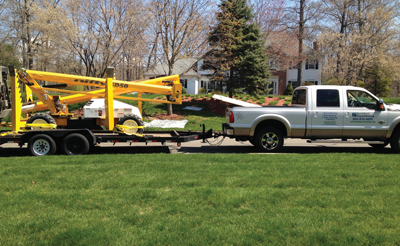 Jim Pasternak, the owner of Northeast Power Washing, based out of Hartford, CT, agrees. He says that safety on any job site is always dependent on the situation and should be taken very seriously. But, when you are working at heights using ladders or lifts, overhead hazards should be your number one concern. To ensure you are equipped with the appropriate safety gear, a thorough site inspection should be done well in advance of having your truck, equipment, and crew show up to perform the work.
Pasternak starts with an inspection of the terrain where boom truck (or ladders) may be stationed. “You must know the load limit that the soil can take and what structures might be buried underground when working with aerial lifts,” warns Pasternak. “If you position equipment on top of a septic tank, for example, it could collapse.”
Recordkeeping Is Key
And, speaking of lifts, Pasternak reminds readers that this type of equipment should be federally inspected and tagged every year, and detailed maintenance records should be kept with the equipment. In the event of an accident that necessitates a visit from the Occupational Health and Safety Association (OSHA), the maintenance log and the operator’s manual that should be located in the basket are the first things the inspector will ask to see. It will help determine whether it was mechanical failure or operator error that may have caused the mishap. Failure to produce such documentation can result in heavy fines.
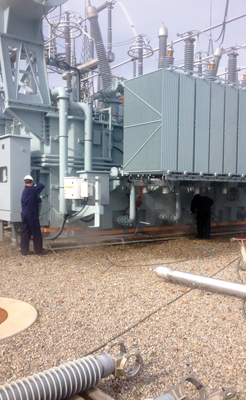
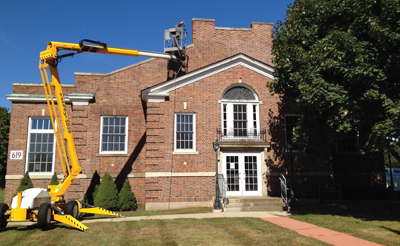 Your pre-inspection will also alert you to whether or not safety harnesses and anchorages will be needed. OSHA has strict guidelines about fall arrest equipment (See Osha Fall Arrest Equipment Guidelines, Condensed). For a job cleaning electrical transformers, for example, Pasternak’s employees were required to wear special, fire-resistant overalls. Your price quote should always include the cost of relevant safety gear and the time it takes to set it up. However, the most important thing you should bring to the worksite is common sense.
Better Safe than Sorry
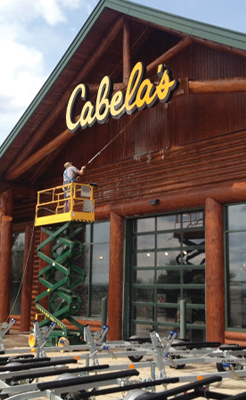 “I learned my lesson many years ago, when I was working on a job that required me to climb to the peak of a rooftop and rappel down the other side,” recalls Pasternak. “I had asked an employee to anchor the safety rope securely to a tree, but thought it wouldn’t hurt to double-check. Sure enough, the rope was not tied correctly. Had I gone up to the roof, the rope would have come undone in a matter of seconds. I would have been in serious trouble! Now, I always double and triple check all connections. And I insist that my employees do the same.”
The anchoring ropes must be tied to something very sturdy, such as a large tree or a big piece of equipment. You can purchase a mobile anchor that you fill with water, but you always have to be mindful that your anchor must be able to withstand the force of a fall. And don’t think that knots are unimportant! Knowing how to properly secure ropes is vital. Pasternak suggests that employers utilize training programs offered by the Power Washers of North America. Safety is a big part of the roof cleaning certification class offered at the annual PWNA convention in October and several times throughout the year in different regions. There are also cell phone apps that demonstrate knot tying and, of course, product representatives can be a great training resource.
Service under Pressure
 Where to position the truck that contains your pressure washers is also a major consideration. Additional hoses are sometimes connected to ensure that technicians can access higher levels. Adding hose length, however, can dramatically reduce the psi and make the pressure cleaning ineffective. If this is the case, it may be necessary to add a second pressure washing unit to ensure adequate psi. To ensure you are not wasting your time—and your customer’s money—do the math in advance and be sure to bring along all of the appropriate equipment.
It is common practice to position the pressure washer on the opposite side of where you will be working when working on a standard pitched roof. This way, the hose comes up and over the top so that the roof peak bears the weight of the hose, and it does not drag the technician off the roof. (A roof protector must be used to avoid damage to the pitch.)
OSHA Fall Arrest Equipment Guidelines, Condensed:
To demonstrate the thoroughness and importance of following safety protocols, below are excerpts from the OSHA Fall Protection Standards. To ensure you are fully compliant and for a complete list of regulations, please visit the OSHA website.
- Connectors shall be made of drop forged, pressed, or formed steel or shall be made of materials with equivalent strength and have a corrosion-resistant finish.
- Surfaces and edges of all connectors shall be smooth to prevent damage to the interfacing parts of the system.
- D-rings and snaphooks shall be capable of sustaining a minimum tensile load of 5,000 pounds and be proof-tested to a minimum tensile load of 3,600 pounds without cracking, breaking, or being permanently deformed.
- Snaphooks shall be sized to be compatible with the member to which they are connected to.
- Anchorages used for attachment of personal, fall arrest equipment shall be independent of any anchorage being used to support or suspend platforms.
- Anchorages shall be capable of supporting at least 5,000 pounds per employee attached.
- When vertical lifelines are used, each employee shall be provided with a separate lifeline.
- Vertical lifelines and lanyards shall have a minimum tensile strength of 5,000 pounds.
- Horizontal lifelines shall be designed, installed, and used under the supervision of a qualified person, and shall only be used as part of a complete, personal, fall arrest system that maintains a safety factor of at least two.
- Self-retracting lifelines and lanyards, which do not limit free- fall distance to two feet or less, rip-stitch lanyards, and tearing and deforming lanyards shall be capable of sustaining a minimum static tensile load of 5,000 pounds applied to the device when they are in the fully extended position.
For the full guidelines, visit http://goo.gl/7jLH8Y.
Ground Manners
Whenever attending to contracts that require technicians to step off of terra firma, you should always have two or more employees at the job site. Someone needs to be able to go for help in the event of an accident and to tend to equipment on the ground.
For standard, residential work, ensuring that curious kids and pets will not be underfoot is usually enough of a precaution. For public buildings or any situation where vehicular and pedestrian traffic is possible, safety cones and flagging tape should be used to cordon off the work area.
With sufficient pre-planning and attention to established safety protocols, your pressure washing business can reach new heights.
Fall Prevention Safety Basics: OSHA Standards and Policy for Non-Construction Work
To demonstrate the thoroughness and importance of following safety protocols, below are excerpts from the OSHA Fall Protection Standards. To ensure you are fully compliant and for a complete list of regulations, please visit the OSHA website.
Type of Height Access Equipment
OSHA Safety Standards, Condensed
Portable Wood Ladders All wood parts shall be free from sharp edges and splinters; sound and free from accepted visual inspection from shake, wane, compression failures, decay, or other irregularities. Low-density wood shall not be used. Portable Metal Ladders Specific design and construction requirements are not part of this section because of the wide variety of metals and design possibilities. However, the design shall be such as to produce a ladder without structural defects or accident hazards such as sharp edges, burrs, etc. The metal selected shall be of sufficient strength to meet the test requirements and shall be protected against corrosion unless inherently corrosion-resistant. Fixed Ladders The minimum design live load shall be a single, concentrated load of 200 pounds. The weight of the ladder and attached appurtenances together with the live load shall be considered in the design of rails and fastenings. Scaffolding The footing or anchorage for scaffolds shall be sound, rigid, and capable of carrying the maximum intended load without settling or displacement. Unstable objects, such as barrels, boxes, loose brick, or concrete blocks shall not be used to support scaffolds or planks. Powered Platforms Equipment must be inspected, tested, and maintained in compliance with the requirements of OSHA guidelines and all protection anchorages must be implemented. Aerial Lifts Aerial equipment may be made of metal, wood, fiberglass reinforced plastic (FRP), or other material; may be powered or manually operated; and are deemed to be aerial lifts whether or not they are capable of rotating about a substantially vertical axis. Get the full details at www.osha.gov/SLTC/fallprotection/standards.html.
Go Mobile