The Southwest Showcase
A Result of Powerful Natural Forces and the Industry of People
By Diane M. Calabrese / Published July 2018

R
egional Profile: Southwest
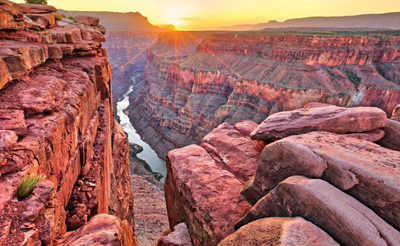
The Land of Enchantment defines the entire Southwest. New Mexico claims the nickname, but Arizona, Colorado, Nevada, Utah, Oklahoma, and Texas also offer majestic natural and man-made vistas.
From the Grand Canyon, Great Salt Lake, and Rio Grande to Hoover Dam, vast oil fields, and growing wind farms, the Southwest showcases results of powerful natural forces and the industry of people.
Mike Schramski, owner of Aamerican Powerwash Equipment and Supplies LLC in Albuquerque, NM, says the region’s beauty makes it a wonderful place to live and work. “I often stop to take pictures or just to look while I am traveling. Even though I’ve passed through some places many times, I still have to stop and look and wonder. That I am so lucky to live in this state is a blessing.”
Those outside the Southwest may be surprised by the distances that must be traversed, but they would also be rewarded in their travels with “truly unbelievable” sunsets and sunrises, says Schramski. His company provides service and sells to all five New Mexico DOT districts—reached by one-way drives of four or five hours.
Hispanic families in northern New Mexico can trace their heritage in the region back more than 400 years, explains Schramski. Farmers, ranchers, cattlemen, and oilfield workers in the southern part of the state have been there for generations. Family and community bonds are strong across the region, which means a product or service that meets with approval garners a strong referral.
Dairies, ranches, farms, heavy equipment shops, and mining are just some of the diverse customers in need of pressure washers and related equipment, says Schramski. Car dealerships, detail shops, and contract cleaners are, of course, also a big part of the customer base.
In March 2018 (most recent figures available from U.S. Bureau of Labor Statistics), employment was technically full or near-full across the Southwest. Colorado had an unemployment rate of just three percent, the lowest in the Southwest, followed by Utah at 3.1 percent.
Variety
“Our area is now known as the Silicon Desert,” says Bill Sommers, president of Pressure Systems Inc. (PSI) in Phoenix, AZ. “The buildings going up house people, not forklifts.”
In today’s business climate, the need is for cold water units along with their gasoline drive power aspects, and not steam cleaners and hot water pressure washers, explains Sommers.
“With a little bit of degreaser and the pressures now available, the cleaning chores are accomplished,” says Sommers. “Clean enough is passable. Major mechanical shops still need sales and repairs. There are four major pressure washer sales companies in the area all vying for their slice of the pie.”
Competing means keeping pace with the changes in the industry as well as the region. Sommer’s company stays busy by providing specialized knowledge both in how to approach difficult jobs—sterilizing, disinfecting, degreasing, cleaning prior to painting, etc., including cutting-edge approaches such as antimicrobial agents and lyophilic coalescents—and offering deep knowledge to keep equipment running.
“Our company does a lot of specialized work for specific problems which the customer can encounter, and they appreciate that and continue to call on us even for the simple answers,” says Sommers. “This comes about because of our total experience with high pressure pump systems.”
Roy G. Chappell, CEO of Chappell Supply and Equipment Co. in Oklahoma City, OK, says he has been surprised by the number of mergers and acquisitions to date in 2018. He notes large companies are buying strong, mid-sized companies, a phenomenon that extends from hog and cattle producers to oil fields.
Oil companies buying mid-sized companies typically follow the purchase with downsizing to one or two large offices and yards, explains Chappell. “These companies want more service and quicker response time.”
High expectations are good. “This creates a great opportunity for those companies that can increase their service and staff to five or six fully-trained service technicians,” says Chappell. Make that technicians with more certification and training just to get on the customer’s property, he adds.
Expect the biggest demand in the Southwest (and beyond) to be for water treatment. Equipment needs will double in the next three to four years, says Chappell. His company has received double the request for quotes in the last two years. Each year it adds to its repertoire—and handling more waste streams opens more doors.
“In the Southwest, all types of manufacturers and metal works are looking for new ways to save water and cut down on costs,” says Chappell. “The powder coating industry is a great industry to call on for wastewater needs.”
Some of the newly designed wastewater bio-systems now handle as much as 90 gallons per minute, says Chappell, although most still fall in the 25–30 gpm range. “Our industry needs to be looking for ways to save water. Water is the next gold rush—a gold rush that has already started.”
We turn to the Lone Star state for perspective on the Southwest from two veterans of the industry: Brenda Purswell, president, and John Purswell, vice president of Alklean Industries Inc. in Pasadena, TX.
Q&A with Brenda Purswell
Cleaner Times [CT]: What would most surprise those outside the Southwest about your region?
Purswell: Customers must capture their water. Most people guess we have a five percent capture rate, but it is closer to 90 percent. The enforcement actions in the Houston metropolis are off the chart compared to other areas. That kills a great many pressure washer sales because the cost to capture and treat the water is exponentially more than just letting it run on the ground or to the storm sewer. The law dates to the early 1970s, but enforcement in our area is much more rigorous than most other areas. People think of Texas as full of wide-open spaces, but certainly that is not true in the Houston area.
CT: What makes the Southwest a particularly interesting place to sell equipment or contractor services?
Purswell: Most of our customers are industrial or commercial. Our market is a very difficult place to contact new customers. It is a rare instance that we are able to walk in and make contact with the person we need to talk to. Many strategies used to canvas for new business are challenging in our area.
CT: What is the greatest challenge for a manufacturer or distributor serving customers in the Southwest?
Purswell: A wide variety of equipment is required to meet needs of customers. Distributors have a hard time just carrying one line of products, and smaller distributors cannot sell enough to satisfy multiple product lines. The industrial customer requires a much more in-depth knowledge of products. It is rare to be able to make a call and leave a piece of equipment. A $10,000 pressure washer requires a typed bid in electronic form with a letter of explanation and many times an AutoCAD drawing of the wash bay and equipment room. Most of the products we sell require remote controls and about 75 percent are gas fired. That is a whole different level of installation with inspectors looking over your shoulder. A lot has changed since when we could drive up, demo a machine, leave it, and bring home a check.
CT: What is the greatest challenge for a contractor in serving customers in the Southwest?
Purswell: Many of our customers are not tolerant of long lead times for service, parts, or new equipment. The large industrial accounts take much longer to pay for their product or service—some up to 180 days, so the distributor must be able to afford his accounts receivable.
CT: What should we have asked you about the cleaning equipment industry in your region?
Purswell: We have been in the business 47-plus years, and we have seen an enormous evolution of the industry. We have been through several booms and conversely oil busts and economy collapses. The largest stationary pressure washer on the market was two horsepower, and most customers thought that would take all the paint off the vehicles. Many jobs did not get done because the time to complete the task was daunting.
We thought we would saturate the market in a couple of years and move on, but equipment evolved to meet demand. Complementary chemicals specialize in so many different ways it is dizzying to try to keep up with them. When we started, you had to pour detergent into the float tank by hand, and for convenience, it came in soda pop bottles (pre-measured). There were no surface cleaners, hose reels, roto nozzles, sewer cleaning nozzles, extendable wands, unloaders, trigger guns for hot water, gasoline or diesel engine hot water machines, and certainly no safety standards. It was the Wild West, indeed. The developments allowed increasing horsepower to power ever greater pressures and volumes to meet market needs. So much to clean and so little time to get it done… What will the next 47 years bring?

Current Digital Issue
|
|
Click to read.
|
Go Mobile