
Patriotic Cleaning
by Diane M. Calabrese | Published July 2026

Support for our country begins with support for our community. Good, local outcomes are cumulative. They add to a bigger positive outcome at the national level. Thus, cleaning the exterior of a commercial or a residential building contributes to patriotism.
A school, a hospital, a civic center—all the structures that enhance cohesion in a community—serve a function day after day. They also bolster feelings of well-being in a community, especially so when they are kept in good condition—unsoiled and in repair.
Most cleaning can be considered patriotic cleaning. Clean community structures, parks, and streets are more hygienic. They are also more aesthetic and safer.
Clean communities may not get noticed as much as those in the opposite condition, but they showcase the day-to-day work that power washing contractors accomplish.
Aesthetic and hygienic surroundings boost cordial interactions among community members. A dumpster coated with residue, oozing unknowns, and emitting odors does not encourage neighbors who meet in a parking lot to pause to exchange pleasantries.
Thus, whether a contractor cleans dumpsters or the U.S. Capitol, the effort should be considered patriotic.
Each day the power washing contractors of the United States contribute to all that is good in our nation, and that’s patriotism in the most robust meaning of the word.
Some contractors have had the opportunity to take on special cleaning projects for local, state, or federal government–projects that contribute to preservation or restoration of a building.
Some contractors as a component of regular business clean government buildings. And many contractors do some cleaning each year as a form of community service.
All the foregoing forms of forging community connections through cleaning are patriotic. Cleaning a national landmark—building or memorial—is high-visibility patriotic cleaning to be sure.
Moreover, contractor members of our industry have had experience cleaning such landmarks both as paid contractors and in community service efforts. Henry Bockman, president of PowerWashCompany.com in Gaithersburg, MD, has deep involvement both ways.
“I’ve done quite a few projects to give back to the community,” says Bockman. “Probably the biggest thing I’ve done was when I created the Clean Across America Campaign with the PWNA.”
The PWNA [Power Washers of North America] Clean Across America launched 23 years ago. The concept was to make assistance with the cleaning of national landmarks, community buildings, and such a way for PWNA members to participate in community service and at the same time to showcase the work that contractors accomplish.
The Clean Across America (CAA) program has gotten much notice. “We won the Take Pride in America Award, and I was honored with an award from President [George W.] Bush’s Thousand Points of Light Awards by the Daily Points of Light Foundation.”
Bockman, a military veteran, has long incorporated giving back to the community in his business. Specializing early on in building restoration, his location in the metropolitan Washington, D.C., region has given him the opportunity to carry out work on some of the best-known structures in the United States.
In August 2006 a group of 16 contractors and suppliers under the CAA umbrella worked in partnership with the U.S. Department of Interior to help clean the Jefferson Memorial and the Lincoln Memorial. The effort was part of Interior’s Take Pride in America Initiative.
Beyond the White House and Washington Monument, few federal structures enjoy the high recognition that the Jefferson Memorial and the Lincoln Memorial do. The memorials to the nation’s third and sixteenth presidents, respectively, were intended by their architects to tell parts of the nation’s story— a story fittingly recalled in 2026 (250 years since the signing of the Declaration of Independence).
The Lincoln Memorial was built first. Designed by Henry Bacon, it was completed during the years 1912 to 1922. The statue of Lincoln within the memorial was the creation of Daniel Chester French.
Pamela Scott and Antoinette J. Lee, writing in Buildings of the District of Columbia (1993, Oxford University Press), explain the Lincoln Memorial was intended by Bacon to be imbued with meaning. Situated along the National Mall with the seat of government (U.S. Capitol) and the obelisk tribute to the “founder of that government” (George Washington), it remembers the “savior” of the government.
The Jefferson Memorial was completed between 1939 and 1943. It was designed by John Russell Pope. (The similarly domed original building at the National Gallery of Art was also designed by Pope). Scott and Lee suggest the Jefferson Memorial is best seen from an aerial vantage.
Marble predominates at the memorials: Vermont white marble at the Jefferson Memorial, and white Colorado marble and pink Tennessee marble at the Lincoln Memorial (which also has Indiana limestone in upper reaches).
Low pressure (below 600 psi) and careful attention to requirements of the Clean Water Act were two of the stringent parameters for the CAA cleaning effort. Wastewater was to be prevented from reaching either the nearby Potomac River or the Tidal Basin.
The volunteers from CAA used hot water at 45 gpm and very low pressure in their efforts. Passersby who caught a view of the ongoing work may have gained a new perspective on power washing, one that showed methods that go far beyond the layperson’s imagining of blasting with water.
The Cooperstown Baseball Hall of Fame in New York may or may not be as well-known as the memorials to Jefferson and Lincoln, but baseball has long been called the national pastime.
Not just the tradition of a national pastime, but something much more. The way in which baseball brings members of a community together in amateur and professional settings makes the Cooperstown site a place that meshes with our understanding of patriotism.
John Tornabene, owner of Clean County Powerwashing in Kings Park, NY, recalls a PWNA CAA effort that he participated in to clean the Cooperstown venue. It was all about giving back, he explains.
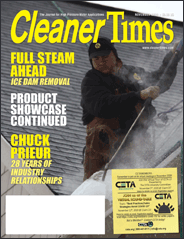
As a happy aside there was a commemorative photo. “I made the cover of the Cleaner Times magazine in 2005 with one of my guys holding the safety rope while I cleaned the gutters.”
Being part of a whole is day-to-day patriotism. Community links are built on each other.
In 2011 Tornabene took on a gratis project that involved only his company. (It’s exemplary of the sort of project that power washing contractors leap forward to accomplish whenever they can.) That was cleaning a Babe Ruth monument.
The cleaning of the neglected monument sparked something bigger. “It was the starting point to eventually get Babe Ruth the Presidential Medal of Freedom [posthumously] from President Trump in 2018,” explains Tornabene.
Tornabene saw the Babe Ruth statue in need and got going to revive it. That’s a familiar pattern of action among professionals in our industry.
Familiar patterns? Count also the thoughts contractors entertain about structures they would like to clean sometimes because a structure symbolizes the nation’s strengths.
“The Washington Monument in D.C. that I visited many times when I was stationed next to the Arlington Cemetery my last two years in the Navy in 1982 to 1986 is a fascinating structure,” says Tornabene. “Today if the opportunity came, we would definitely use a drone on it to make it look better than new.”
The Washington Monument was the tallest structure in the world when completed in 1884. Designed by Robert Mills, it was built from 1845 to 1854 and then the design was completed by Thomas Lincoln Casey from 1876 to 1884. (Yes, the U.S. Civil War along with money issues and political differences put a long pause on the completion of the project. But eventually everyone did return to the idea of a monument to the first president, one that expressed gratitude.)
Trying to imagine that the Washington Monument ranked as the tallest structure in the world fewer than 150 years ago forces realization of how fast things can change. Patriotic endeavors make stronger the bridges needed to span years and decades.
The General Services Administration (GSA), established in 1947, is an independent entity that oversees the federal (public) buildings across the United States. GSA compiles, recommends, and sometimes mandates practices for building maintenance and restoration. (GSA.gov is an excellent place to begin a search for best practices in cleaning everything from historic masonry to polishing and cleaning brass plate.)
Interested in the least intrusive approaches that produce good outcomes, GSA was an early adopter of soft washing. In 2019, for example, it highlighted the successful use of the method to clean the John W. Solomon Building and U.S Courthouse in Chattanooga, TN. Dating to 1932, the building had decades of soiling that left it looking like a graffiti-filled railway embankment.
When members of a community can take time to reflect—whether at a national landmark or in a remarkably clean park (benches, tables, walkways, dumpsters, etc.)—they become inspired to do their part to replicate the good that they see in real time or commemorated.
Active participation in civic life requires much more than talking. It demands the doing that makes each of us patriots.

Current Digital Issue
|
|
Click to read.
|


Go Mobile